
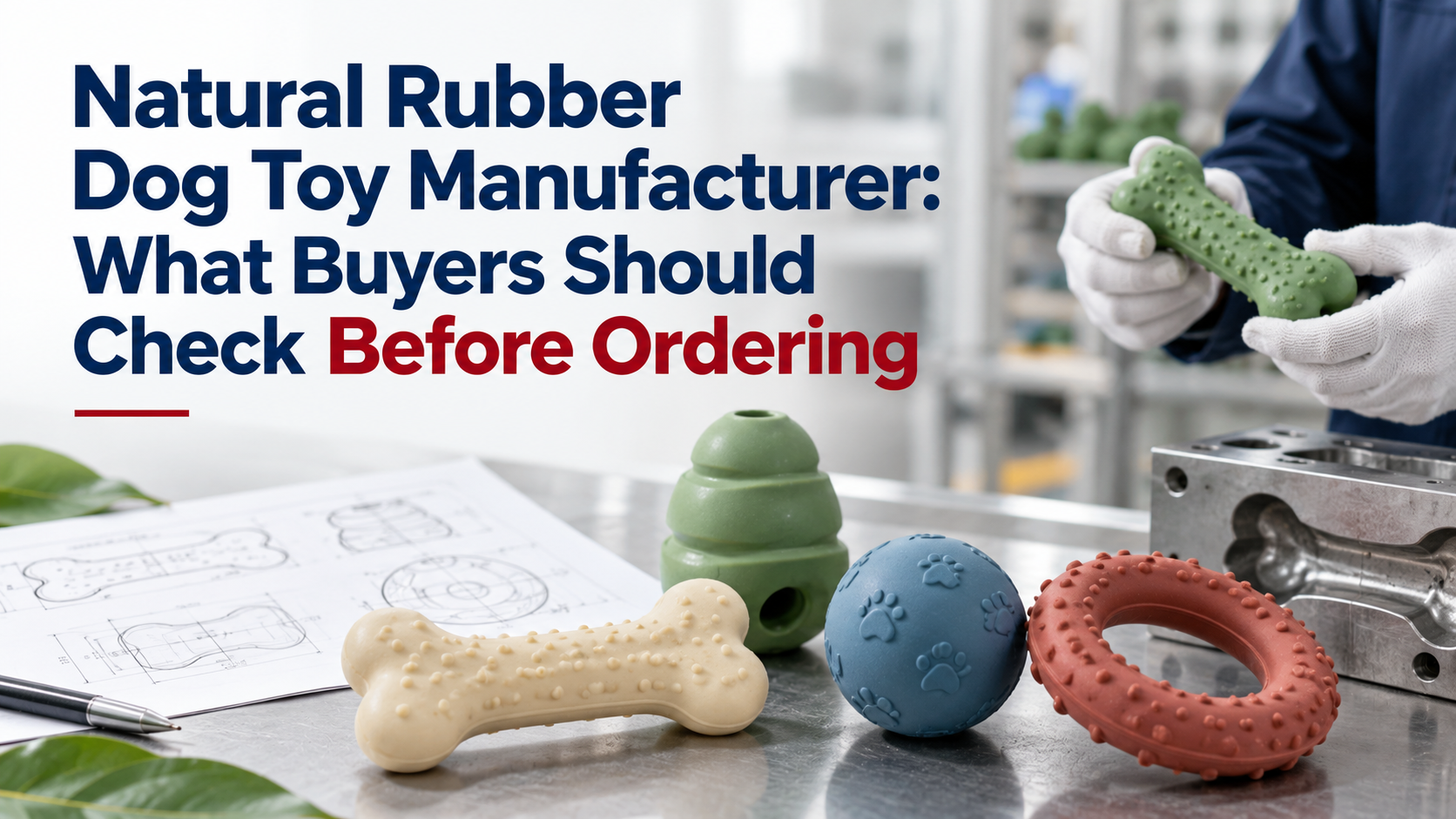
Choosing a natural rubber dog toy manufacturer requires more than comparing product photos, unit prices, and minimum order quantities.
For pet brands developing chew toys, treat dispensers, rubber balls, tug toys, or other molded products, the manufacturer's experience with rubber formulation, hardness, product structure, tooling, curing, testing, and quality control can directly affect how the finished toy performs.
Two factories can quote products that look nearly identical while using different rubber compounds, mold structures, processing conditions, wall thicknesses, and quality-control standards.
For buyers, the more useful question is therefore not simply: “Can this factory make a rubber dog toy?”
It is: “Does this manufacturer understand how material, product design, tooling, and production work together?”
What Does Natural Rubber Dog Toy Manufacturing Involve?
Natural rubber dog toys are normally produced through a series of material-preparation, molding, curing, finishing, and inspection steps.
The exact process depends on product geometry, rubber formulation, mold structure, hardness, color, logo method, and production volume.
This is why natural rubber toys should not be treated as generic molded products.
1. Check Whether the Manufacturer Specializes in Natural Rubber
Not every dog toy factory has the same material capability.
A supplier that mainly manufactures TPR or TPE injection-molded toys may not have the same experience with natural rubber compounding, vulcanization, curing, trimming, and batch control.
When evaluating a factory, ask:
- How long have you manufactured natural rubber products?
- What types of rubber dog toys do you currently produce?
- Do you control rubber mixing and color preparation?
- What hardness ranges can you produce consistently?
- How do you control curing conditions?
- How do you manage flash and surface defects?
- Can you support custom rubber formulations?
The answers should be specific to rubber manufacturing rather than generic statements such as “we can make all pet products.”
2. Understand the Rubber Compound, Not Just the Material Name
“Natural rubber” describes the material category, but it does not completely define how the finished toy will behave.
A finished compound may be adjusted according to:
- Target hardness
- Elasticity
- Tear resistance
- Tensile performance
- Rebound
- Color
- Processing requirements
- Product geometry
This is one reason two natural rubber dog toys can feel and perform differently even when both are described simply as “natural rubber.”
3. Do Not Select a Dog Toy by Shore Hardness Alone
Shore A hardness is one of the most common specifications used when discussing rubber dog toys.
But hardness does not equal durability.
A harder toy may feel stronger in the hand, yet still fail if the design contains weak structural areas.
Durability can also depend on:
- Wall thickness
- Product geometry
- Tear strength
- Internal cavities
- Large openings
- Sharp internal corners
- Narrow neck sections
- Deep texture channels
- Likely bite points
A qualified manufacturer should review hardness together with product structure rather than treating hardness as the only design variable.
For more detail, see our guide on natural rubber vs. TPR vs. silicone for dog toys .
4. Evaluate Tear Resistance and Structural Weak Points
Dog toys experience concentrated forces rather than uniform pressure.
Dogs often bite repeatedly at:
- Edges
- Openings
- Texture transitions
- Thin necks
- Protruding features
- Internal cavities
This means a design can fail even when the bulk material itself has acceptable tensile properties.
During development, the manufacturer should identify areas where stress may concentrate and determine whether the design needs:
- More wall thickness
- A larger radius
- A smaller opening
- A shallower texture
- A stronger connection section
- A different hardness or formulation
These adjustments are often easier and less expensive before mold production begins.
5. Ask for DFM Before Tooling
DFM—Design for Manufacturing—is especially important for custom molded rubber dog toys.
A product may look good in CAD but still create problems during molding, curing, demolding, or trimming.
A DFM review can examine:
- Parting-line location
- Wall thickness
- Draft and demolding
- Texture depth
- Undercuts
- Logo placement
- Venting
- Flash-sensitive areas
- Internal cavities
- Mold filling behavior
If a manufacturer sends a mold quotation without discussing any of these issues for a complicated new design, ask how manufacturability has been evaluated.
6. Confirm Mold Development and Ownership
Custom tooling is one of the most important parts of an original rubber dog toy project.
Before approving tooling, confirm:
- Who designs the mold?
- Who machines the mold?
- What mold material will be used?
- How many cavities will it have?
- What production volume is it designed for?
- Who owns the mold?
- Is the mold exclusive to your brand?
- Where will the tooling be stored?
- Who pays for modifications?
- Who handles future maintenance?
Mold ownership should never be assumed simply because a tooling fee has been paid.
If the product is proprietary, ownership and permitted use should be clearly documented.
7. Review the Sampling Process Carefully
The first molded sample is where design assumptions become a physical product.
Do not approve it based only on appearance.
Check the sample for:
- Overall dimensions
- Product weight
- Shore hardness
- Flexibility
- Rebound
- Wall thickness
- Surface texture
- Logo position
- Treat openings
- Squeaker function if applicable
- Parting lines
- Flash
- Deformation
- Color consistency
- Packaging fit
If the product needs revision, confirm whether the change requires only processing adjustments or physical mold modification.
8. Ask How the Manufacturer Controls Curing
Rubber curing is a critical part of molded rubber production.
Molding temperature, pressure, cure time, product thickness, and material formulation can affect the finished product.
Poor process control can contribute to:
- Incomplete curing
- Surface defects
- Dimensional variation
- Inconsistent hardness
- Deformation
- Variation between production batches
For repeat orders, stable process control is just as important as producing a good first sample.
9. Understand Material Testing vs. Finished-Product Testing
Buyers often ask whether a rubber material has passed a particular chemical or physical test.
That is useful, but material testing and finished-product testing answer different questions.
| Testing Type | What It Evaluates | Examples |
|---|---|---|
| Material Testing | Raw material or rubber compound characteristics | Hardness, tensile strength, tear strength, chemical composition |
| Finished Product Testing | Performance and consistency of the molded dog toy | Dimensions, weight, deformation, function, visual quality, product-specific checks |
A compliant material does not automatically guarantee a durable finished toy.
Product geometry and manufacturing consistency also matter.
10. Ask What Quality Control Happens During Production
The challenge in mass production is not making one good piece.
It is making thousands of pieces within an acceptable specification.
A natural rubber dog toy manufacturer may control:
- Incoming raw materials
- Rubber mixing
- Color batches
- Material weight
- Molding parameters
- Cure time
- Hardness
- Product dimensions
- Flash
- Surface defects
- Logo appearance
- Final packaging
Ask the supplier which parameters are recorded and how production batches are identified.
11. Check Color-Matching Capability
Color consistency can be important for pet brands building coordinated product collections.
Ask whether the manufacturer supports:
- Pantone color references
- Custom pigment matching
- Pre-production color samples
- Batch-to-batch color control
- Multi-color product programs
Exact appearance can vary depending on rubber formulation, pigment, lighting, surface texture, and material thickness.
Therefore, final color approval should ideally be based on a physical production sample rather than only a screen image.
12. Evaluate Logo and Branding Options
Different logo methods have different durability and visual effects.
Depending on product structure, options may include:
- Embossed logo
- Debossed logo
- Molded-in branding
- Surface printing
- Printed packaging
- Hangtags or labels
For products designed for repeated chewing, molded branding can often be more suitable than certain surface-applied decoration methods.
The logo should also be positioned where it does not weaken the product structure or create an unwanted bite point.
13. Compare MOQ Based on the Level of Customization
There is no universal MOQ for natural rubber dog toys.
MOQ can change depending on:
- Existing vs. new mold
- Product weight
- Rubber compound
- Custom color
- Logo method
- Packaging
- Number of SKUs
- Production complexity
A product using an existing mold with a standard color may have a different MOQ from a proprietary product requiring a new mold, custom compound, and printed retail packaging.
Instead of asking only for the factory's minimum MOQ, request the MOQ for your exact specification.
14. Compare Total Project Cost, Not Just Unit Price
For a custom rubber dog toy, the total project can include:
- Product development
- CAD and engineering
- Mold development
- Sampling
- Rubber material
- Molding
- Trimming
- Logo application
- Testing
- Packaging
- Inspection
- Freight
A lower unit price may not create a lower total cost if the mold requires repeated modifications, defect rates are high, or the product cannot maintain consistent quality.
15. Check Production Capacity Before Scaling
The factory that is suitable for a first small order should also be evaluated for future growth.
Ask about:
- Number of molding machines
- Daily or monthly output
- Peak-season capacity
- Multi-cavity tooling
- Additional mold requirements
- Material availability
- QC staffing
- Packaging capacity
- Repeat-order lead time
If your expected order quantity may increase significantly, discuss scalability before finalizing the mold design.
Natural Rubber Dog Toy Manufacturer Checklist
Before choosing a supplier, confirm the following:
- Natural rubber molding is a core capability
- The factory can explain its rubber compound and hardness options
- DFM is completed before tooling
- Weak structural areas are reviewed
- Mold ownership is clearly defined
- Prototype samples are available before mass production
- Hardness and dimensions can be controlled
- Material and finished-product testing are clearly separated
- Quality checks occur during production
- Pantone colors and branding can be supported
- MOQ is based on the actual project specification
- Packaging requirements are confirmed in advance
- Production capacity can support repeat orders
Red Flags When Choosing a Rubber Dog Toy Manufacturer
- The supplier cannot explain the rubber formulation or hardness
- Every product is described simply as “pet safe rubber”
- No DFM review is offered before tooling
- The factory avoids questions about mold ownership
- There is no structured sampling process
- Material testing is presented as proof of finished-product durability
- The supplier cannot explain curing or process control
- No production QC records are available
- A final quotation is given without dimensions, weight, or material specification
A technically capable supplier should be willing to discuss limitations, risks, and trade-offs—not only confirm that every request is possible.
Questions to Ask Before Ordering
What natural rubber compounds do you normally use?
What Shore A hardness ranges can you control?
How do you evaluate tear-sensitive areas in the design?
Do you provide DFM before mold production?
Who designs and owns the mold?
How do you control curing conditions?
What physical tests can you perform?
How do you check batch consistency?
Can you Pantone-match custom colors?
What logo methods are available?
What is the MOQ for my exact specification?
Can you support custom packaging?
How will production scale if my volume increases?
Existing Mold, Modified Design, or Fully Custom Toy?
Not every project requires a completely new mold.
Pet brands can generally approach customization at different levels.
| Customization Level | Typical Changes | Tooling Requirement |
|---|---|---|
| Light Customization | Color, logo, packaging | Existing mold |
| Medium Customization | Size, texture, hardness, selected functional changes | Existing or modified tooling |
| Full Custom Development | New structure, exclusive shape, new function | New custom mold |
You can learn more about Newtop Pets OEM and ODM customization options .
Frequently Asked Questions
What is a natural rubber dog toy manufacturer?
A natural rubber dog toy manufacturer produces molded dog toys using natural-rubber-based compounds and manufacturing processes such as material mixing, molding, curing, trimming, inspection, and finishing.
Is harder rubber always more durable for dog toys?
No. Shore hardness affects how the product feels and deforms, but durability also depends on tear strength, wall thickness, product geometry, rubber formulation, openings, textures, and stress concentration areas.
What Shore hardness is best for a natural rubber dog toy?
There is no single hardness suitable for every design. The appropriate Shore A range depends on product size, wall thickness, flexibility, chewing behavior, function, and structural design.
Can I create a completely custom natural rubber dog toy?
Yes. An OEM/ODM manufacturer can potentially support product design, 3D development, DFM, custom tooling, material selection, samples, colors, logos, packaging, and mass production.
What should I check in a rubber dog toy sample?
Check dimensions, weight, hardness, flexibility, rebound, wall thickness, surface texture, openings, parting lines, flash, logo placement, color, deformation, and packaging fit.
What is the MOQ for custom natural rubber dog toys?
MOQ depends on product weight, mold, material, color, logo, packaging, number of SKUs, and customization level. Buyers should request the MOQ for the exact product specification.
How long does it take to develop a custom rubber dog toy?
Development time depends on design complexity, DFM, tooling, sample revisions, material requirements, testing, packaging, and production quantity. A fully custom project normally takes longer than an existing-mold private-label product.
Final Thoughts
Selecting a natural rubber dog toy manufacturer should not be based on price or hardness alone.
The performance of a molded rubber toy comes from the combination of material formulation, product geometry, wall thickness, tooling, curing, process control, and quality inspection.
A good manufacturing partner should be able to explain how these factors interact and identify potential product risks before mass production begins.
For existing products, custom colors, logos, and packaging may be enough.
For differentiated products, buyers may need changes to hardness, texture, dimensions, or function.
For proprietary designs, look for an OEM/ODM manufacturer capable of supporting the complete process from concept and DFM through tooling, sampling, mass production, QC, and packaging.
Looking for a Natural Rubber Dog Toy Manufacturer?
Newtop Pets supports pet brands, wholesalers, distributors, and private-label projects with custom molded natural rubber dog toys.
From existing-product customization to new structures, Shore hardness, Pantone colors, logos, custom molds, prototypes, packaging, and mass production, we support different levels of OEM and ODM development.
Start Your Custom Project →
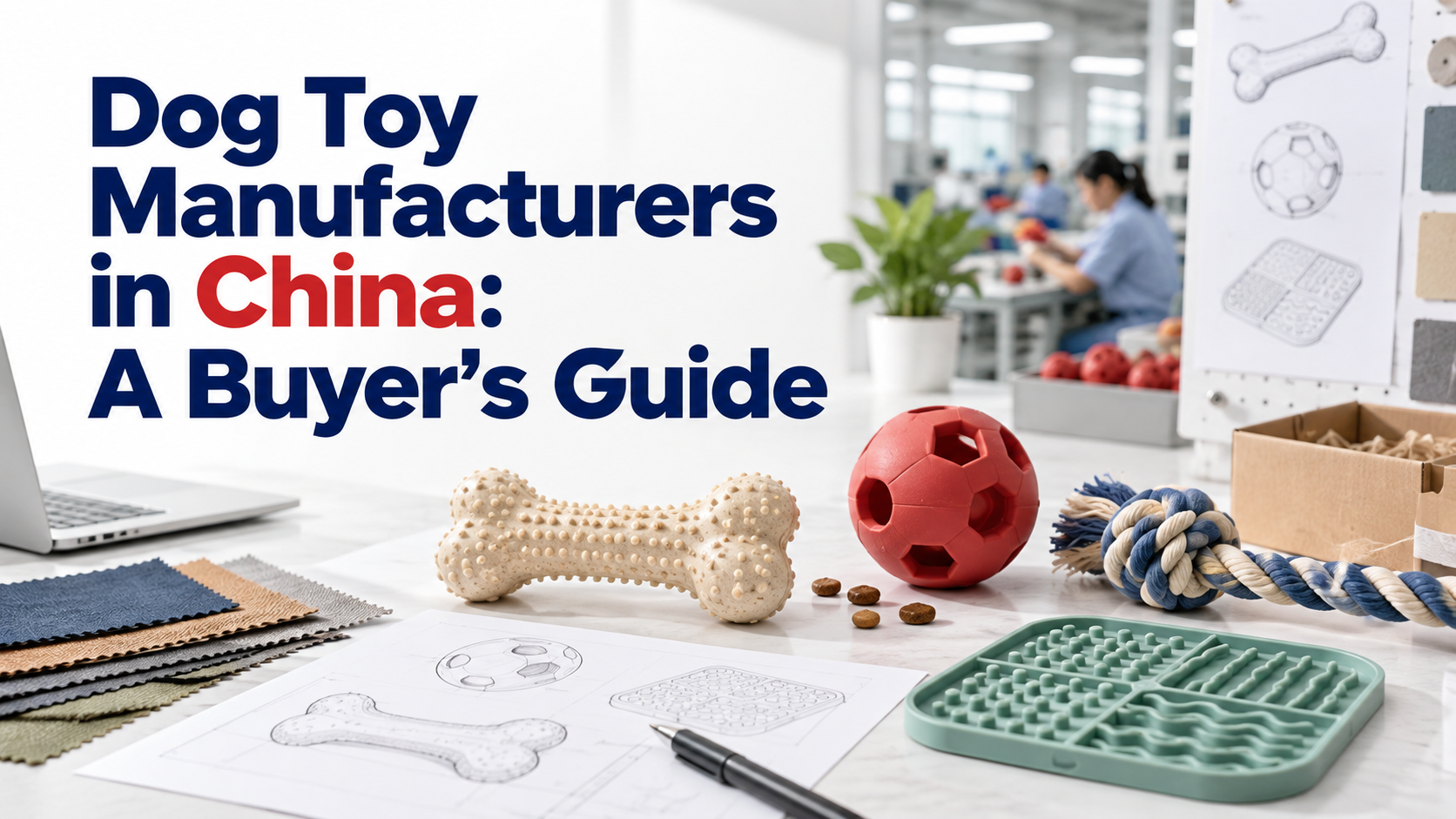
China has a large and diverse pet-product manufacturing ecosystem, but finding the right dog toy manufacturer in China requires more than simply searching for the lowest unit price.
Different factories specialize in very different products and processes. One supplier may focus on plush dog toys, another on molded natural rubber products, while others manufacture nylon chews, TPR toys, silicone enrichment products, or rope toys.
For pet brands, wholesalers, distributors, and private-label buyers, the real sourcing question is therefore not:
“Can I find dog toys in China?”
It is:
“Which Chinese manufacturer has the right material, engineering, tooling, testing, and production capabilities for my product?”
What Does Custom Dog Toy Manufacturing in China Look Like?
A fully custom project normally moves through several development and production stages.
A supplier that only offers existing products with logo printing is very different from an OEM or ODM manufacturer capable of developing an original product.
Why Do Pet Brands Source Dog Toys From China?
China’s manufacturing advantage is not simply low-cost production.
The larger advantage is access to a broad supply chain covering materials, tooling, molding, printing, packaging, assembly, testing, and export logistics.
This allows pet brands to source and develop many different categories, including:
- Natural rubber chew toys
- Rubber dog balls
- Treat-dispensing toys
- Squeaky rubber toys
- TPR and TPE toys
- Nylon dog chews
- Rope toys
- Plush dog toys
- Silicone lick mats
- Silicone slow feeders
- Interactive enrichment products
- Outdoor pet accessories
However, these product types are not necessarily manufactured by the same kind of factory.
That is why supplier specialization matters.
1. Start With the Dog Toy Category
Natural Rubber Dog Toys
Natural rubber is commonly used for molded products such as:
- Chew toys
- Treat dispensers
- Rubber balls
- Tug toys
- Squeaky molded toys
- Puzzle toys
- Dental-texture toys
Manufacturing may involve rubber mixing, color preparation, compression molding, curing, demolding, trimming, inspection, and secondary processing.
If your project is a natural rubber product, look specifically for a manufacturer with rubber-molding experience rather than simply searching for a general pet-products supplier.
TPR and TPE Dog Toys
TPR and TPE are thermoplastic materials that can be injection molded.
They are commonly used for:
- Flexible chew toys
- Balls
- Dental toys
- Textured products
- Multi-material toys
These materials use a different production process from vulcanized natural rubber.
Nylon Dog Toys
Nylon chews are normally injection molded and provide a significantly harder chewing surface.
A factory specializing in rubber products may not necessarily have nylon injection-molding capability.
Plush Dog Toys
Plush manufacturing depends heavily on:
- Fabric sourcing
- Cutting
- Sewing
- Embroidery
- Filling
- Squeaker assembly
- Stitching strength
This is a fundamentally different manufacturing system from molded rubber toys.
Silicone Pet Products
Silicone is commonly used for feeding and enrichment products such as:
- Lick mats
- Slow feeder bowls
- Feeding mats
- Travel bowls
- Treat pouches
- Flexible pet accessories
You can explore Newtop Pets' silicone slow feeder and lick mat manufacturing capabilities for more examples.
2. Factory vs. Trading Company: What Is the Difference?
When searching online, many suppliers appear to be factories. Some are manufacturers, some are trading companies, and some combine both business models.
A factory normally controls production directly, while a trading company typically manages sourcing and customer communication through one or more manufacturing partners.
Neither model is automatically good or bad.
The important issue is transparency.
For a custom project, you should know:
- Where the product is actually manufactured
- Who controls the mold
- Who develops or selects the material
- Who approves engineering changes
- Where samples are manufactured
- Where quality inspection takes place
- Who is responsible for defects
- Whether you can communicate with the technical team
For a simple existing product, a trading company may work perfectly well.
For a complicated custom rubber dog toy, direct access to engineering, tooling, and production becomes much more important.
3. Check Whether the Manufacturer Offers OEM or ODM Services
Not every dog toy supplier in China provides the same level of customization.
| Model | Product Structure | Color / Logo | New Mold | Engineering Support |
|---|---|---|---|---|
| Wholesale | Existing | Limited | No | Low |
| Private Label | Existing | Yes | Usually No | Low |
| OEM | Existing or Custom | Yes | Possible | Medium |
| ODM | Custom | Yes | Yes | High |
If you already have a finished 3D drawing and specifications, OEM manufacturing may be sufficient.
If you only have a sketch, reference image, concept, or functional requirement, you may need deeper ODM support.
Learn more about Newtop Pets OEM and ODM customization .
4. Evaluate the Manufacturer’s Material Expertise
One of the most common sourcing mistakes is assuming that all flexible pet toys are manufactured in the same way.
Natural rubber, TPR, TPE, silicone, and nylon have different:
- Material properties
- Molding methods
- Tooling requirements
- Hardness ranges
- Tear behavior
- Surface characteristics
- Production costs
- Quality risks
For natural rubber chew toys, ask specifically about:
- Rubber formulation
- Shore A hardness
- Tear strength
- Tensile properties
- Wall thickness
- Curing
- Odor control
- Color consistency
- Flash control
- Post-processing
A supplier should be able to explain how the material and product structure work together.
5. Check Whether the Factory Can Help Improve the Design
An attractive 3D rendering is not automatically a manufacturable dog toy.
Design problems can include:
- Walls that are too thin
- Narrow neck sections
- Deep grooves
- Oversized treat openings
- Sharp internal corners
- Weak squeaker cavities
- Difficult demolding geometry
- Uneven material distribution
This is why DFM—Design for Manufacturing—should happen before mold production.
An experienced factory may recommend adjusting wall thickness, texture depth, hole size, product radius, parting lines, hardness, or internal cavities before tooling.
6. Ask Who Designs and Manufactures the Mold
For a custom dog toy, tooling can be one of the largest upfront investments.
Before ordering a mold, ask:
- Is mold design handled internally?
- Who machines the mold?
- What mold material will be used?
- How many cavities will it contain?
- What is the expected mold life?
- Who owns the mold?
- Is the mold exclusive?
- Where will it be stored?
- Who pays for modifications?
- Who pays for future maintenance?
Paying a mold fee does not automatically mean you own the tooling.
Ownership and exclusivity should be confirmed before payment.
7. Never Skip the Sampling Stage
A production sample should be treated as an engineering checkpoint, not simply a color sample.
Check:
- Dimensions
- Weight
- Hardness
- Flexibility
- Surface finish
- Texture
- Treat opening
- Wall thickness
- Bounce
- Squeaker performance
- Logo placement
- Parting line
- Flash
- Packaging fit
A small problem at the prototype stage is much easier to solve than the same problem across thousands of mass-produced units.
8. Ask How the Factory Controls Quality
One good sample does not guarantee consistent production.
Ask how quality is controlled throughout the manufacturing process.
Incoming Inspection
Materials and components are checked before production.
First Article Inspection
Initial production pieces are compared with the approved specification.
In-Process Inspection
Production can be monitored for dimensions, weight, hardness, appearance, and other critical parameters.
Final Inspection
Finished products are checked before packing or shipment.
For molded rubber toys, QC may include:
- Shore A hardness
- Dimensions
- Product weight
- Surface appearance
- Flash
- Color consistency
- Deformation
- Tear or tensile properties
- Functional testing
- Batch records
9. Understand Testing Before You Place an Order
“Pet safe” is not a complete technical specification.
Testing requirements can depend on material, product structure, destination market, retailer requirements, and product claims.
Before production, ask:
- Which tests can be performed internally?
- Which tests require a third-party laboratory?
- Does the report cover raw material or finished products?
- Who pays for testing?
- How long does testing take?
- What happens if a sample fails?
It is important to separate material compliance from finished-product performance.
10. Do Not Compare Suppliers Only by MOQ
There is no universal MOQ for custom dog toys.
MOQ can change according to:
- Product material
- Size
- Weight
- Color
- Custom tooling
- Logo process
- Packaging
- Accessories
- Customization level
Instead of asking only:
“What is your MOQ?”
ask:
“What MOQ applies to this exact specification?”
11. Compare Total Cost, Not Just Unit Price
A supplier with the lowest unit price is not automatically the lowest-cost supplier.
A custom dog toy project may include:
- Product design
- CAD development
- Prototypes
- Tooling
- Raw materials
- Manufacturing
- Logo application
- Testing
- Packaging
- Inspection
- Freight
Before comparing quotations, make sure each supplier is quoting the same material, dimensions, weight, hardness, quantity, color, logo, packaging, testing, and trade terms.
12. Check Packaging Capability
Many pet brands need retail-ready products rather than loose toys.
Ask whether the supplier supports:
- Polybags
- Hangtags
- Header cards
- Paper sleeves
- Color boxes
- Display boxes
- Barcode labels
- Custom inserts
- Instruction sheets
- Master cartons
Packaging MOQ should also be considered when planning your first production order.
13. Check Whether the Supplier Can Scale With Your Brand
The best supplier for a small test order may not be the best supplier for a large repeat order.
Ask about:
- Current production capacity
- Number of molding machines
- Peak-season lead times
- Additional tooling requirements
- Multi-cavity tooling
- Material availability
- Packaging capacity
- QC staffing
- Repeat-order lead times
14. Ask for a Clear Project Timeline
Custom manufacturing should be broken into milestones.
Do not rely only on a statement such as:
“Lead time: 30 days.”
That figure may refer only to mass production after the final sample has already been approved.
What Should You Send a Chinese Dog Toy Manufacturer?
Your first RFQ does not need to be perfect, but it should provide enough information for the manufacturer to understand your project.
Include:
- Product photo, sketch, drawing, or 3D file
- Approximate dimensions
- Preferred material
- Target hardness if known
- Dog size or intended use
- Estimated quantity
- Number of colors
- Pantone requirements
- Logo
- Packaging
- Target market
- Testing requirements
- Target launch date
If some information is still unknown, tell the manufacturer.
A good supplier should help convert incomplete requirements into a clear production specification.
Red Flags When Choosing a Dog Toy Factory in China
- Cannot clearly explain where production takes place
- Refuses to discuss material specifications
- Provides a final quotation from only one photo
- Cannot explain its molding process
- Avoids questions about mold ownership
- Has no clear sampling process
- Changes specifications without documentation
- Cannot explain its QC process
- Promises every possible material and process
A strong manufacturer does not need to say yes to everything.
Identifying what cannot be manufactured reliably can actually be a sign of better technical judgment.
Questions to Ask a Dog Toy Manufacturer in China
Do you manufacture this product in your own facility?
What materials do you specialize in?
Can you support OEM and ODM development?
Can you start from a sketch or product concept?
Who designs and owns the mold?
Can you provide prototype samples?
How do you control hardness and dimensions?
What testing can you support?
What is the MOQ for my exact specification?
Can you provide custom packaging?
What is the tooling lead time?
What is the mass-production lead time?
How do you handle defective products?
Can production scale when order volume increases?
China vs. U.S. Dog Toy Manufacturing
Both China and the United States have established dog toy manufacturers.
The right sourcing location depends on the project rather than one country being universally better.
| Factor | China | USA |
|---|---|---|
| Custom Tooling | Widely available | Available |
| OEM / ODM Ecosystem | Broad | Supplier dependent |
| U.S. Domestic Shipping | International freight required | Simpler |
| Supply Chain Breadth | Broad across many categories | More supplier-specific |
| Packaging Integration | Widely available | Supplier dependent |
| Engineering Support | Supplier dependent | Supplier dependent |
| MOQ | Depends on project | Depends on project |
For more detail, see our guide to dog toy manufacturers in the USA .
Example: Custom Rubber and Silicone Pet Manufacturing in China
Newtop Pets is a China-based OEM/ODM pet-product manufacturer focused on custom natural rubber dog toys and silicone pet products.
Depending on the project, customization can include:
- Pantone color matching
- Custom logos
- Custom packaging
- Product dimensions
- Texture changes
- Shore hardness options
- Functional adjustments
- 3D design support
- New mold development
- Prototype sampling
- Exclusive product development
Explore our dog toy product range or review our OEM and ODM customization process .
Frequently Asked Questions
Are dog toys manufactured in China?
Yes. China manufactures many types of dog toys, including natural rubber toys, TPR and TPE products, nylon chews, plush toys, rope toys, silicone enrichment products, and pet accessories.
How do I find a dog toy manufacturer in China?
Start with your product type and material, then compare suppliers based on specialization, tooling, OEM/ODM capability, sampling, quality control, testing, MOQ, packaging, production capacity, and communication.
Can Chinese manufacturers make a dog toy from my design?
Yes. Some OEM/ODM manufacturers can work from a 3D file, drawing, sketch, reference product, or early product concept. The amount of engineering support depends on the supplier.
What is the MOQ for custom dog toys in China?
There is no universal MOQ. It depends on material, product size, manufacturing process, color, logo, packaging, tooling requirements, and customization level.
How much does a custom dog toy mold cost in China?
There is no standard mold price. Cost depends on product size, mold dimensions, complexity, number of cavities, mold material, textures, undercuts, and expected production volume.
Who owns the mold when manufacturing in China?
Mold ownership depends on the agreement with the manufacturer. If exclusivity matters, ownership, storage, permitted use, maintenance, and restrictions should be confirmed before tooling begins.
Is China suitable for private-label dog toys?
Yes. Many suppliers offer private-label services such as custom colors, logos, packaging, labels, and product variations. Private labeling, however, is different from developing a fully original OEM or ODM product.
Final Thoughts
China offers a broad dog toy manufacturing ecosystem, but successful sourcing depends on choosing the right type of supplier.
Do not choose a manufacturer simply because it appears first in a marketplace search or offers the lowest quotation.
Start with your product.
Define the material, function, customization level, target quantity, market, testing requirements, and packaging.
Then choose a manufacturer whose material expertise, engineering capability, tooling, sampling process, quality control, communication, and production capacity match those requirements.
For a standard product, private labeling may be sufficient.
For a modified product, deeper OEM support may be required.
For a proprietary dog toy developed from a concept or sketch, look for an ODM manufacturing partner capable of supporting the complete process from design through mass production.
Looking for a Custom Dog Toy Manufacturer in China?
Newtop Pets supports pet brands, wholesalers, distributors, and private-label programs with custom natural rubber dog toys and silicone pet products.
From existing-product customization to 3D development, new molds, prototypes, colors, logos, packaging, and mass production, we support different levels of OEM and ODM projects.
Start Your Custom Project →
Finding a custom dog toy manufacturer is different from simply finding a supplier that already sells dog toys.
If you are developing products for your own pet brand, you may need a manufacturer that can support material selection, product design, 3D drawings, mold development, prototypes, testing, branding, packaging, and mass production—not just add your logo to an existing product.
The right manufacturing partner also depends on what you are making. A natural rubber chew toy, nylon bone, plush toy, silicone enrichment product, and treat-dispensing ball all require different materials, equipment, engineering experience, and quality-control processes.
For pet brands, wholesalers, distributors, and product developers, the more useful question is not simply “Who makes dog toys?” but:
“Which manufacturer has the right capabilities to develop and consistently produce my dog toy?”
What Does a Custom Dog Toy Manufacturing Process Look Like?
For a fully original dog toy, the development process generally follows several stages.
If a supplier cannot clearly explain how it will take your product through these stages, it may be better suited to wholesale sourcing than true custom manufacturing.
1. Start With the Type of Dog Toy You Want to Manufacture
Before contacting factories, define the basic product category. Different dog toys can require completely different materials, equipment, and manufacturing processes.
A natural rubber chew toy may require rubber formulation, mixing, compression molding, curing, trimming, and post-processing.
A silicone lick mat may require a different mold structure, food-contact material requirements, texture design, suction-cup engineering, and flexibility targets.
A nylon chew normally requires injection molding, while a plush toy depends heavily on fabric sourcing, cutting, sewing, filling, and stitching quality.
This means that a factory with experience manufacturing plush toys is not automatically qualified to manufacture durable molded rubber dog toys.
When comparing suppliers, ask how much experience they have with your exact product category and material.
2. Understand Wholesale, Private Label, OEM and ODM
These terms are often used interchangeably, but they represent different levels of customization.
| Model | Existing Product | Custom Color / Logo | Product Modification | New Mold | Development Support |
|---|---|---|---|---|---|
| Wholesale | Yes | Usually No | No | No | Low |
| Private Label | Yes | Yes | Limited | Usually No | Limited |
| OEM | Existing or New | Yes | Yes | Possible | Medium |
| ODM | Existing or New | Yes | Yes | Yes | High |
Wholesale works when you simply want to purchase an existing product.
Private label is useful when the product can remain largely unchanged but you want your own colors, logo, labels, or packaging.
OEM manufacturing is more suitable when you already have defined specifications and need a manufacturer to produce the product.
ODM manufacturing is useful when you have an idea, sketch, reference sample, or functional requirement but still need engineering and product-development support.
You can learn more about Newtop Pets' OEM and ODM customization options .
3. Check the Manufacturer’s Material Experience
Material selection is one of the most important decisions in dog toy development.
Common materials include:
- Natural rubber
- Synthetic rubber
- TPR
- TPE
- Silicone
- Nylon
- Fabric
- Rope
For molded chew toys, material choice affects more than appearance. It can influence hardness, rebound, flexibility, tear resistance, odor, weight, texture, production method, mold design, and cost.
Natural rubber is widely used for durable chew and enrichment toys because it can provide a combination of elasticity, grip, rebound, and tear resistance.
Silicone is more commonly used for feeding and enrichment products such as lick mats, slow feeders, bowls, and feeding mats.
Nylon is typically used where a much harder chewing surface is required.
A qualified manufacturer should be able to explain why a particular material is suitable for your product rather than simply asking you to choose from a material list.
4. Do Not Choose a Dog Toy Based on Shore Hardness Alone
When developing rubber dog toys, buyers often focus on a specific Shore A hardness.
Hardness matters, but it is only one part of durability.
Two rubber dog toys using the same Shore hardness can perform very differently because durability is also affected by:
- Wall thickness
- Product geometry
- Tear strength
- Rubber formulation
- Sharp corners
- Treat openings
- Internal cavities
- Thin connection points
- Likely bite areas
Increasing hardness may make a toy feel tougher, but it will not necessarily solve a weak structural point around a thin neck, deep groove, or oversized opening.
An experienced natural rubber dog toy manufacturer should review both material properties and product structure.
5. Ask Whether the Factory Can Support Product Design and DFM
You do not always need a finished CAD file before contacting a manufacturer.
A capable OEM/ODM manufacturer may be able to begin with:
- A sketch
- A reference photo
- An existing product
- Rough dimensions
- A 3D file
- A functional concept
The concept still needs to be converted into a manufacturable product.
Typical DFM questions include:
- What should the wall thickness be?
- Where should the mold parting line go?
- Can the product demold correctly?
- Are any sections too thin?
- Will deep textures create tear points?
- Is the treat opening appropriately sized?
- Where should the logo be positioned?
- Will the product deform during molding?
- Can the design be produced consistently at scale?
Solving these issues before tooling is usually much cheaper than modifying a finished mold later.
6. Confirm Who Makes and Owns the Mold
For a fully custom dog toy, tooling is one of the most important parts of the project.
Before paying a tooling fee, confirm:
- Who designs the mold?
- Who manufactures the mold?
- Who owns the mold?
- Is the tooling exclusive to your company?
- Where will it be stored?
- How many cavities will it have?
- What mold material will be used?
- Are minor modifications included?
- Who pays for future mold maintenance?
Mold ownership is especially important when developing a proprietary design.
Do not assume that paying a tooling charge automatically means the mold belongs exclusively to you. Confirm the arrangement in writing.
7. Evaluate the Prototype and Sampling Process
A sample is not only for checking color.
For a new dog toy, evaluate:
- Dimensions
- Weight
- Hardness
- Flexibility
- Wall thickness
- Surface texture
- Grip
- Bounce
- Treat fit
- Squeaker performance
- Logo position
- Surface finish
If the toy contains openings, thin sections, internal cavities, multiple materials, or a squeaker, inspect those areas carefully.
Sampling should identify potential problems before mass production, when changes are still relatively easy to make.
8. Ask How the Manufacturer Tests Dog Toys
Testing should be discussed before mass production, not after the order has already been completed.
Depending on the product, molded rubber dog toy QC may involve:
- Shore A hardness checks
- Dimensional inspection
- Weight checks
- Tensile testing
- Tear strength testing
- Visual inspection
- Flash inspection
- Deformation checks
- Functional testing
- Batch records
It is important to distinguish between material testing and finished-product testing.
Passing a raw-material test does not automatically prove that a finished dog toy is suitable for every use or chewing condition.
9. Understand the MOQ Before Comparing Prices
There is no universal MOQ for custom dog toys.
MOQ can depend on:
- Product size
- Product weight
- Material
- Color
- Manufacturing process
- Custom mold requirements
- Printing or logo process
- Packaging
- Accessories
- Overall customization level
An existing product with custom branding normally requires less development than a completely new product with exclusive tooling.
When contacting manufacturers, explain whether you are testing a new SKU, modifying an existing design, or developing a completely proprietary product.
10. Compare Total Project Cost, Not Just Unit Price
One of the most common sourcing mistakes is selecting a manufacturer only because it offers the lowest unit price.
A custom dog toy project may include costs for:
- Product development
- 3D design
- Prototype development
- Tooling
- Raw material
- Molding
- Secondary processing
- Logo application
- Accessories
- Testing
- Packaging
- Inspection
- Freight
When comparing quotations, make sure every manufacturer is quoting against the same material, dimensions, weight, hardness, quantity, logo method, packaging specification, and trade terms.
Otherwise, two apparently similar prices may represent completely different products.
11. Review the Factory’s Quality-Control Process
Dog toys are functional products, so visual appearance alone does not prove production consistency.
Ask where quality checks take place throughout production.
For molded products, QC may include:
- Incoming material inspection
- Production-process monitoring
- First-article inspection
- Dimensional checks
- Hardness testing
- Appearance inspection
- Weight tolerance checks
- Functional testing
- Final inspection
- Batch traceability
For a long-term supplier relationship, consistency between batches is often more important than producing one excellent sample.
12. Check Custom Color, Logo and Packaging Capabilities
Product differentiation does not end with the mold.
Depending on your project, confirm whether the manufacturer supports:
- Pantone color matching
- Multiple product colors
- Embossed logos
- Debossed logos
- Printing
- Labels and hangtags
- Retail boxes
- Custom inserts
- Barcodes
- Master cartons
Logo selection should take product material and function into account. A molded logo, for example, may be more suitable than surface printing on certain products designed for repeated chewing.
13. Evaluate Communication Before Placing an Order
Communication during the quotation stage often indicates what production communication will be like.
If you send only a reference image and immediately receive a final quotation without any discussion of material, dimensions, weight, hardness, testing, packaging, or order quantity, the price may be based largely on assumptions.
A strong manufacturing partner should ask questions, identify risks, explain trade-offs, record revisions, and confirm specifications before production.
For a custom project, a manufacturer that identifies a problem in your design can be more valuable than one that simply agrees with every request.
14. Factory or Trading Company: Does It Matter?
Working directly with a factory can provide advantages when a project requires detailed engineering, material adjustments, tooling changes, or repeated sampling.
However, the business model alone does not determine supplier quality.
What matters is transparency.
You should know:
- Who actually manufactures the product
- Who controls the tooling
- Who makes engineering decisions
- Where quality inspection happens
- Who is responsible when a production problem occurs
For proprietary product development, direct access to engineering and manufacturing teams can be especially valuable.
15. What Information Should You Send to a Dog Toy Manufacturer?
You do not need a perfect specification sheet to start a project. However, better input usually leads to more accurate technical feedback and quotations.
A useful initial RFQ can include:
- Product idea, drawing, CAD file, or reference image
- Preferred material
- Approximate dimensions
- Target dog size or intended use
- Target hardness, if known
- Estimated order quantity
- Target market
- Color requirements
- Logo requirements
- Packaging preference
- Required testing
- Target launch timing
- Target price range, if available
If some of these details are unknown, say so.
An experienced manufacturer should help identify what needs to be clarified before tooling begins.
Questions to Ask Before Choosing a Custom Dog Toy Manufacturer
Does the manufacturer specialize in my product and material?
Can it support design and engineering, or only production?
Who makes and owns the mold?
Can I inspect a prototype before mass production?
How does the factory control material and production consistency?
What testing can be performed?
What is included in the quotation?
What is the MOQ for my level of customization?
Can the manufacturer handle custom packaging?
How are quality problems handled?
Can the supplier scale production if my orders increase?
How Long Does Custom Dog Toy Development Take?
There is no single standard timeline.
A private-label product using an existing mold can move much faster than a completely original design requiring CAD development, new tooling, sample revisions, testing, and custom packaging.
Development time can be affected by:
- Design complexity
- Mold structure
- Number of revisions
- Material availability
- Testing requirements
- Packaging approval
- Production quantity
Instead of asking only for a final delivery date, ask for project milestones.
Local vs. Overseas Dog Toy Manufacturers
Both local and overseas manufacturing can work.
A local supplier may offer easier domestic communication, shorter transportation distances, and simpler replenishment for certain products.
An overseas OEM/ODM manufacturer may offer broader supply-chain access, custom tooling capabilities, multiple production processes, and more competitive manufacturing economics for some higher-volume projects.
The right decision depends on your product complexity, customization, MOQ, budget, launch schedule, target market, and supply-chain strategy.
For proprietary products, manufacturing capability should usually matter more than geography alone.
How to Choose the Right Manufacturer for Your Pet Brand
The best custom dog toy manufacturer is not necessarily the biggest factory or the supplier with the lowest quotation.
It is the manufacturer whose material knowledge, engineering ability, tooling, production process, quality control, customization options, communication, and capacity match your project.
If you are purchasing a standard product, private labeling may be enough.
If you want to adjust size, texture, hardness, functionality, or components, you need deeper OEM customization.
If you are creating a completely original product, look for a supplier with real ODM capabilities and a clear process from concept through tooling and mass production.
Frequently Asked Questions
What is a custom dog toy manufacturer?
A custom dog toy manufacturer produces dog toys according to a buyer's specific requirements. Customization can range from color, logo, and packaging changes to entirely new product structures, materials, molds, and functions.
Can I manufacture a dog toy from just an idea?
Yes. Some OEM/ODM manufacturers can begin with a sketch, reference image, existing product, or concept. The idea then needs to be converted into engineering specifications and a manufacturable design before tooling.
How much does it cost to manufacture a custom dog toy?
There is no fixed cost. Pricing depends on material, size, product weight, mold complexity, quantity, logo method, packaging, testing, and whether new tooling is required.
What is the MOQ for custom dog toys?
MOQ varies by product and customization level. Existing-mold private-label products generally require less development than completely custom products with new tooling.
Who owns a custom dog toy mold?
Mold ownership depends on the agreement between the buyer and manufacturer. Ownership, storage, exclusivity, and future mold maintenance should be confirmed in writing before tooling begins.
Which material is best for dog chew toys?
There is no single best material for every dog toy. Natural rubber, TPR, TPE, silicone, and nylon have different hardness, flexibility, durability, manufacturing, and cost characteristics. The material should match the intended function and product structure.
How do manufacturers test rubber dog toys?
Depending on the product, manufacturers may evaluate hardness, dimensions, weight, tensile properties, tear strength, visual quality, deformation, functionality, and production consistency. Additional third-party testing may also be required depending on the target market.
Looking for a Custom Dog Toy Manufacturer?
Newtop Pets supports pet brands, wholesalers, distributors, and private-label projects with custom natural rubber dog toys and silicone pet products.
From colors, logos, and packaging to 3D design, custom molds, prototypes, sampling, and mass production, we can support different levels of OEM and ODM development.
Start Your Custom Project →
Several companies manufacture dog toys in the United States, including West Paw, KONG, SodaPup, Goughnuts, Ruff Dawg, Jolly Pets, Monster K9, and Van Ness Pet Products.
For retailers, distributors, and pet brands, it is important to understand not only where a dog toy is made, but also what materials the manufacturer specializes in, what types of products it produces, and whether it offers wholesale, private-label, OEM, or ODM services.
Below is a comparison of several established dog toy companies in the USA, their locations, product specialties, and official websites.
Dog Toy Manufacturers in the USA: Quick Comparison
| Company | Logo | Location | Main Products | Official Website |
|---|---|---|---|---|
| West Paw |  | Bozeman, Montana | Chew toys, fetch toys and enrichment products | westpaw.com |
| KONG |  | Golden, Colorado | Natural rubber chew and enrichment toys | kongcompany.com |
| SodaPup |  | Colorado | Rubber toys, nylon chews, lick mats and enrichment products | sodapup.com |
| Goughnuts |  | Modesto, California | Natural rubber toys for aggressive chewers | goughnuts.com |
| Ruff Dawg |  | Worcester, Massachusetts | Molded rubber chew and retrieving toys | ruffdawg.com |
| Jolly Pets |  | Streetsboro, Ohio | Balls, chew toys, tug toys and outdoor dog toys | jollypets.com |
| Monster K9 |  | Erie, Pennsylvania | Heavy-duty rubber dog toys | monsterk9.com |
| Van Ness Pet Products |  | Clifton, New Jersey | Molded plastic pet products and selected dog toys | vannesspets.com |
1. West Paw — Bozeman, Montana
U.S. dog toy manufacturer based in Bozeman, Montana
Visit Official Website →West Paw is one of the better-known American dog toy companies with significant domestic manufacturing. The company is based in Bozeman, Montana and is particularly recognized for molded chew, fetch, and enrichment products.
Its product range includes:
- Durable chew toys
- Treat-dispensing toys
- Dog puzzle toys
- Fetch toys
- Interactive enrichment products
Products such as Toppl, Hurley, Tux, Qwizl and Zisc demonstrate how one material platform can be developed into a broader product family with different functions and sizes.
Best known for: Premium molded dog toys and enrichment products.
2. KONG — Golden, Colorado
Rubber dog toy company headquartered in Golden, Colorado
Visit Official Website →KONG is one of the most recognizable dog toy companies in the world and is closely associated with durable natural rubber chew and enrichment products.
Its range includes:
- Stuffable rubber dog toys
- Rubber chew toys
- Dog balls
- Extreme-chewer products
- Puppy dog toys
- Senior dog toys
- Treat-dispensing products
For pet product developers, KONG is a useful reference for how rubber formulation, wall thickness, cavity design, shape and sizing can be adjusted for different dogs and chewing behaviors.
Best known for: Natural rubber chew and treat-dispensing dog toys.
SodaPup focuses strongly on dog enrichment and combines conventional dog toys with feeding, licking, chewing, and mental-stimulation products.
Its range includes:
- Rubber treat dispensers
- Rubber dog toys
- Nylon dog chews
- Lick mats
- Slow feeder bowls
- Enrichment trays
SodaPup is particularly relevant to brands studying how to build coordinated product collections around enrichment rather than relying on a single dog toy SKU.
Best known for: Dog enrichment toys, lick mats, slow feeders and rubber products.
Goughnuts specializes in durable natural rubber products designed for aggressive chewers.
Its product range includes:
- Rubber rings
- Chew sticks
- Rubber dog balls
- Tug toys
- Heavy-duty chew products
One notable feature used in some Goughnuts products is an internal safety indicator that can help owners identify when a toy has experienced excessive wear.
It is also a useful example of why durability depends on more than rubber hardness. Product geometry, thickness, bite areas, tear resistance and material formulation all influence performance.
Best known for: Natural rubber toys for aggressive chewers.
Ruff Dawg is particularly interesting from a manufacturing perspective because the brand is connected with Jefferson Rubber Works, a rubber molding company in Worcester, Massachusetts.
Products include:
- Solid rubber balls
- Rubber rings
- Floating dog toys
- Fetch products
- Treat-fillable toys
- Heavy-duty chew toys
Ruff Dawg also sells through wholesale channels. However, wholesale availability should not automatically be considered equivalent to OEM or custom dog toy manufacturing.
Best known for: U.S.-molded solid rubber dog toys.
6. Jolly Pets — Streetsboro, Ohio
Dog toy company based in Streetsboro, Ohio
Visit Official Website →Jolly Pets offers a broad range of dog toys developed for chasing, chewing, tugging, retrieving and outdoor play.
Its product categories include:
- Large dog balls
- Soccer-style dog balls
- Chew toys
- Tug toys
- Fetch products
- Floating toys
- Outdoor dog toys
Because the company offers many different product types, buyers should verify the manufacturing origin of individual products rather than assuming that every SKU comes from the same production location.
Best known for: Durable balls and outdoor dog toys.
Monster K9 focuses primarily on heavy-duty dog toys for aggressive chewers and working dogs.
Its products include:
- Rubber chew rings
- Chew sticks
- Rubber balls
- Flying discs
- Tug toys
- Working-dog products
Monster K9 provides another useful reference for pet brands researching durability, product thickness and tear resistance for aggressive-chewer products.
Best known for: Heavy-duty rubber dog toys.
8. Van Ness Pet Products — Clifton, New Jersey
U.S. molded plastic pet product manufacturer
Visit Official Website →Van Ness Pet Products is a long-established American pet product company with extensive experience in molded plastic pet products.
The company is relevant to buyers researching:
- Injection-molded pet products
- Plastic dog products
- Pet feeding products
- Selected plastic dog toys
- High-volume molded pet accessories
Its manufacturing background makes Van Ness a different reference point from companies focused primarily on natural rubber chew toys.
Best known for: Injection-molded plastic pet products.
Do U.S. Dog Toy Companies Offer Private Label or Custom Manufacturing?
Not always. A company can make dog toys in the United States without offering custom manufacturing services to outside brands. Buyers should confirm the supplier's business model before requesting a quote.
Brand Manufacturer
Some U.S. companies operate their own manufacturing equipment or facilities primarily to produce products sold under their own consumer brand.
Wholesale Supplier
A wholesale supplier sells existing products to retailers or distributors. This usually does not include exclusive molds, major structural changes, or proprietary product development.
Private-Label Supplier
Private-label programs may allow buyers to add branding, packaging, colors, or other limited changes to an existing product.
Contract or Custom Manufacturing
Buyers that need an original product should confirm whether a U.S. supplier accepts outside development projects, including custom tooling, product engineering, prototypes, testing, and production.
In other words, made in the USA and available for custom manufacturing are two different questions. Confirm both before selecting a supplier.
What Types of Dog Toys Are Commonly Manufactured in the USA?
Rubber Dog Toys
Rubber is one of the most common materials used for durable molded dog toys.
- Chew toys
- Treat-dispensing toys
- Rubber balls
- Rings
- Tug toys
- Dental toys
- Interactive enrichment toys
KONG, Goughnuts, Ruff Dawg and Monster K9 are notable examples within this category.
Dog Enrichment Products
Enrichment is becoming an increasingly important category within the pet industry.
Products include:
- Treat dispensers
- Puzzle toys
- Lick mats
- Slow feeders
- Enrichment trays
Plastic Dog Toys
Injection molding and other plastic manufacturing methods can be used to manufacture dog discs, balls, outdoor toys, feeding accessories and other rigid pet products.
Nylon Dog Chews
Nylon can be molded into durable chewing products with different shapes, textures, sizes and chewing surfaces. These products are particularly common for aggressive chewers.
How to Evaluate a Dog Toy Manufacturer in the USA
If you are comparing U.S. dog toy manufacturers, location is only one factor. Buyers should also compare material expertise, production capabilities, testing support, order requirements, and whether the company works with outside brands.
1. Confirm Where the Product Is Actually Made
A U.S.-based brand may sell products made in more than one country. Verify the country of origin for the specific product or SKU you plan to purchase.
2. Check Material and Process Capabilities
Common dog toy materials and processes include:
- Natural and synthetic rubber molding
- Injection-molded plastics
- Nylon molding
- Fabric and plush construction
- Silicone or TPE products
The supplier should have relevant experience with the material and manufacturing process required for your product category.
3. Verify the Supplier's Business Model
Ask whether the company sells only its own branded products, offers wholesale programs, provides private label, or accepts custom development projects for third-party brands.
4. Review Testing and Documentation
Ask what material documentation, quality-control procedures, and product testing can be provided for your destination market.
5. Compare MOQ, Lead Time, and Total Sourcing Cost
Depending on the supplier, compare:
- Minimum order quantity
- Unit price
- Tooling or setup fees, if applicable
- Sample cost
- Packaging options
- Production lead time
- Domestic freight
- Quality-control support
These factors help determine whether a U.S. supplier fits your purchasing model, whether you are sourcing an existing product or developing something more customized.
U.S. Dog Toy Manufacturers vs. Overseas Suppliers
U.S. manufacturing can be attractive when buyers prioritize domestic sourcing, shorter domestic supply chains, or easier replenishment. However, supplier capabilities vary widely, and not every U.S. dog toy company accepts private-label or custom development projects.
For brands developing an original product, compare suppliers based on the actual services required for the project, such as tooling, prototyping, material options, testing support, packaging, MOQ, production capacity, and quality control.
If your priority is an original product with custom molds, materials, colors, branding, or packaging, see our custom dog toy manufacturing capabilities .
Frequently Asked Questions
What companies make dog toys in the USA?
Examples include West Paw in Montana, KONG in Colorado, Goughnuts in California, Ruff Dawg in Massachusetts, Monster K9 in Pennsylvania, Jolly Pets in Ohio and other U.S.-based pet product manufacturers.
What are some American rubber dog toy manufacturers?
KONG, Goughnuts, Ruff Dawg and Monster K9 are among the better-known American companies associated with molded rubber dog toys.
Are KONG dog toys made in the USA?
Many KONG natural rubber dog toys are manufactured in the United States. However, the company also sells other product categories, so buyers should verify the country of origin of the specific SKU.
Are Goughnuts dog toys made in the USA?
Goughnuts states that its natural rubber dog toys are molded in Modesto, California.
Can U.S. dog toy manufacturers make custom products for my brand?
Some companies may provide wholesale, private-label or contract manufacturing services. However, many established consumer dog toy companies manufacture primarily for their own brands.
If you need an exclusive mold, original product structure, custom colors, logo and packaging, specifically confirm whether the supplier offers OEM or ODM manufacturing.
What should I ask a U.S. dog toy manufacturer before buying?
Confirm the product's country of origin, material, available sizes, MOQ, wholesale or private-label options, production lead time, testing documentation, packaging options, and whether the company accepts custom projects for outside brands.
Final Thoughts
The United States has several established dog toy companies across rubber toys, enrichment products, outdoor toys, and molded pet products. KONG, West Paw, Goughnuts, Ruff Dawg, SodaPup, Jolly Pets, Monster K9, and Van Ness are useful starting points for buyers researching the U.S. market.
When comparing suppliers, verify the manufacturing location of the specific product, the company's sales model, material expertise, order requirements, and whether it offers wholesale, private label, contract manufacturing, or custom development.
If you need a proprietary product rather than an existing U.S.-made SKU, compare suppliers separately for engineering, tooling, testing, customization, production, and quality-control capabilities.
Need Custom Manufacturing Beyond U.S. Suppliers?
If your project requires an original design, custom tooling, material selection, private-label packaging, or OEM/ODM development, Newtop Pets supports custom dog toy projects for brands, wholesalers, and distributors.
View Custom Dog Toy Manufacturing →
Pet owners are looking for products that support chewing needs, enrichment, training, indoor activity, dental care, slow feeding, anxiety relief, and stronger interaction between pets and owners.
For pet brands, retailers, and distributors, this shift creates a clear product development direction. Dog toys need to be designed not only for appearance, but also for material safety, durability, chewing behavior, enrichment function, target dog size, cleaning convenience, packaging presentation, and long-term replacement demand.
At Newtop Pets, our product focus includes natural rubber dog toys, silicone slow feeders and lick mats, and custom OEM/ODM pet product programs for brands that need practical manufacturing support.
Market Data Snapshot
APPA reported U.S. pet industry expenditures reached $158 billion in 2025 and projected $165 billion in 2026.
APPA reported 95 million U.S. households owned a pet according to its 2025 National Pet Owners Survey cited in the 2026 State of the Industry Report.
Grand View Research reported the dog toys segment held the largest pet-type market share in 2025.
Future Market Insights expects chew toys to capture approximately 36.0% of global pet toy product-type demand in 2026.
1. Dog Toys Remain the Core of the Pet Toy Market
Dog toys continue to dominate because dogs have strong daily play, chewing, training, and enrichment needs. Grand View Research reported that dog toys accounted for 52.2% of the pet toys market in 2025. Future Market Insights also identifies dogs as the leading pet type in global pet toy demand.
This matters for pet product brands because dog toys are usually repeat-purchase products. A dog may destroy, lose, or outgrow toys faster than many other durable products. Puppies, adult dogs, senior dogs, small breeds, large breeds, and aggressive chewers all need different toy types.
From a manufacturing and product development perspective, this creates room for segmented product lines, such as:
- Puppy teething toys.
- Heavy-duty chew toys.
- Treat-dispensing toys.
- Puzzle and enrichment toys.
- Fetch balls.
- Floating outdoor toys.
- Squeaky toys.
- Soft comfort toys.
- Dental texture toys.
- Slow feeding and licking toys.
The brands that perform better in this category are usually not selling “one toy for all dogs.” They are building toy collections around dog size, chewing strength, play style, and daily use scenario. If you are developing a mixed toy line, our dog toy manufacturer page outlines natural rubber, nylon, plush, squeaky, and enrichment toy directions.
2. Chew Toys Are Still One of the Strongest Product Types
Chew toys remain one of the most important dog toy categories. Future Market Insights estimates that chew toys will account for 36.0% of the global pet toys product-type segment in 2026. Grand View Research also reported that chew pet toys accounted for 25.4% of the pet toys market in 2025.
This trend is easy to understand. Chewing is a natural behavior for dogs. It can help dogs release energy, reduce boredom, and redirect destructive chewing away from furniture, shoes, or household objects. For puppies, chewing is also closely linked to teething. For adult dogs, chew toys can be part of daily enrichment and stress relief.
However, chew toys are also one of the most technically demanding categories. A good chew toy needs to be durable enough for real use, but not so hard that it may damage teeth. It also needs to avoid sharp edges, weak points, loose parts, or materials that break into unsafe pieces.
This is why material selection is critical. Natural rubber, durable thermoplastic materials, and carefully designed nylon-style products are commonly used in the chew toy category. For brands focused on safer and more flexible chewing, natural rubber is often a strong option because it provides elasticity, bite resistance, and a softer mouthfeel than many hard plastics.
 Chew toys, treat-dispensing toys, and enrichment toys are becoming more function-driven rather than purely decorative.
3. Natural Rubber Is Gaining Attention for Durable and Safer Chewing
Material choice is becoming one of the biggest differentiators in the dog toy market. Consumers are paying more attention to whether toys are safe, durable, easy to clean, and suitable for the dog’s chewing habits.
Natural rubber is especially relevant for dog toys such as chew toys, treat-dispensing toys, balls, tug toys, and enrichment toys. Compared with hard plastic, natural rubber can offer better flexibility and bounce. Compared with plush or rope toys, molded rubber toys usually have stronger resistance to chewing and tearing.
The market is not moving toward one material only. Different materials serve different toy functions. For brands, the practical material direction is:
- Natural rubber: chew toys, balls, treat toys, and tough interactive toys.
- Fabric and plush: comfort toys, light play, and small-dog products.
- Rope: tug products, with proper safety and supervision warnings.
- TPE or other flexible materials: lightweight products and certain mid-range toy structures.
- Silicone: licking toys, feeding enrichment products, and soft daily-use pet products.
- Recycled or natural fibers: eco-positioned product lines.
From a manufacturer’s point of view, natural rubber dog toys need careful control over hardness, formula, odor, wall thickness, molding quality, and post-processing. The product should not only look durable. It must also perform consistently in real chewing and play conditions.
For material comparison, see our article: Natural Rubber vs TPR vs Silicone: Which Material Wins for Chew Toys and Why.
4. Enrichment and Interactive Toys Are Moving from Niche to Mainstream
One of the clearest trends in dog toys is the growth of enrichment-based design. Pet owners increasingly understand that dogs need mental stimulation, not only physical exercise.
This supports the growth of toys such as:
- Puzzle toys.
- Treat-dispensing balls.
- Rubber toys with snack cavities.
- Lick toys.
- Slow-feeding enrichment toys.
- Snuffle mats.
- Scent-based toys.
- Training toys.
- Wobble toys.
For product development, this trend means brands should think beyond “play.” A dog toy can also be positioned as an enrichment tool, a boredom reducer, a training aid, or a feeding activity product.
This is especially important for urban pet owners. Dogs living in apartments or smaller indoor spaces may need toys that provide engagement without requiring a large outdoor area. Compact, quiet, easy-to-clean enrichment toys can fit this lifestyle well.
5. Treat-Dispensing and Food-Based Toys Are Growing Because They Extend Play Time
Treat-dispensing toys are popular because they combine play with reward. They can keep dogs engaged for longer periods and create a more active feeding experience.
This category includes rubber treat balls, hollow chew toys, puzzle feeders, licking toys, slow feeders, and toys designed to hold frozen treats or wet food. Many of these products are also connected to the broader trend of slow feeding and enrichment feeding.
For dog toy brands, treat-dispensing products have several advantages:
- They give the toy a clear function.
- They encourage repeat use.
- They can be marketed for boredom relief or enrichment.
- They are suitable for content creation and social media videos.
- They can be developed in different difficulty levels.
- They work well with food, treats, paste, and frozen recipes.
The key challenge is design. The opening size, internal cavity, wall thickness, flexibility, treat-release speed, cleaning access, and dog size all need to be considered. If the toy releases food too easily, it loses enrichment value. If it is too difficult, the dog may lose interest.
Natural rubber is a strong material for many treat-dispensing dog toys because it can be molded into hollow shapes, flexible openings, textured surfaces, and durable chew structures. One example direction is our freeze treat-dispensing dog toy.
Manufacturer’s View: Treat Toys Need Function Testing
A treat-dispensing toy should be tested with real food sizes, wet fillings, frozen recipes, and target dog sizes. The best structure is not simply the hardest or most complex one. It is the structure that keeps the dog engaged without making the product frustrating or hard to clean.
6. Plush and Comfort Toys Still Have Strong Demand, but Durability Is a Limitation
Plush toys remain popular because they are soft, lightweight, visually attractive, and suitable for gentle play. For many pet owners, plush toys are not only for chewing. Dogs may carry them, sleep with them, shake them, or use them as comfort objects.
Plush toys also perform well in seasonal collections, holiday themes, licensed designs, and social media-friendly product lines.
However, plush toys have clear limitations. They are usually not suitable for aggressive chewers. Stuffing, squeakers, threads, and loose parts may create safety concerns if the dog tears the toy apart. This does not mean plush toys are bad, but they should be positioned correctly.
A good plush toy strategy should separate:
- Comfort plush toys for gentle dogs.
- Reinforced plush toys for moderate play.
- No-stuffing plush toys for reduced mess.
- Crinkle plush toys for sound interaction.
- Squeaky plush toys for engagement.
- Seasonal plush toys for gifting and retail display.
For brands, plush toys can work well as part of a wider dog toy collection, but they should not be the only product direction if the target customers also need durable or chew-resistant options.
7. Squeaky Toys Remain Popular, but Buyers Care More About Safety and Noise Control
Squeaky toys continue to attract dogs because sound can trigger attention, excitement, and play behavior. They are common in plush toys, rubber balls, chew toys, and interactive toys.
The market opportunity is still strong, but buyer expectations are changing. Pet owners want toys that are fun without being too annoying, unsafe, or easy to destroy. For manufacturers, this means the squeaker structure must be carefully designed.
Important design considerations include:
- Whether the squeaker is securely enclosed.
- Whether the material around the squeaker is strong enough.
- Whether the toy can maintain sound after repeated biting.
- Whether the sound level is acceptable for indoor use.
- Whether the toy is suitable for the target dog size.
- Whether the toy needs a replaceable or non-removable squeaker.
Squeaky rubber toys can be a useful direction because molded rubber provides stronger structure than many low-cost plush squeaky toys. For this product direction, see our squeaky dog toy manufacturer page.
8. Sustainability Is Becoming a Product Selection Factor, but Price Still Matters
Sustainability is no longer just a marketing concept. Consumers are increasingly concerned about materials, packaging, chemical safety, plastic waste, and long-term product value.
For pet toys, sustainability can appear in several ways:
- Natural rubber instead of petroleum-based plastic.
- Recycled rubber or recycled plastic materials.
- Organic cotton or hemp rope.
- Recycled fabric for plush toys.
- FSC-certified paper packaging.
- Reduced plastic packaging.
- Durable toys designed for longer use.
- Replaceable parts instead of disposable toys.
However, sustainability must be balanced with durability and cost. Pet owners may like eco-friendly claims, but if the toy breaks too quickly or costs too much, repeat purchase may be weak. For dog toys, “eco-friendly” alone is not enough. The product also needs to be safe, functional, durable, and appropriate for the dog’s behavior.
For brands, the practical opportunity is to use sustainability as part of the value proposition, not the whole value proposition. A stronger message would be: natural rubber, durable design, safe material, reduced packaging, and practical enrichment function.
9. Value-Oriented Premiumization Is Replacing Simple Premium Pricing
The pet toy market is not moving only toward expensive products. It is moving toward products that justify their price.
APPA’s market data shows the pet industry is still growing, while Packaged Facts notes that durable pet products are facing headwinds and that opportunities remain around value, health, and wellness. This means brands cannot rely only on emotional pet-parent marketing. They need to show real product value.
In dog toys, value can come from:
- Longer durability.
- Multi-function design.
- Safer materials.
- Better fit for dog size and chewing style.
- Easy cleaning.
- Retail-ready packaging.
- Replacement or refillable features.
- Strong branding and product storytelling.
- Better after-sales trust.
This is important for wholesalers and retailers. A product with a slightly higher unit price can still be attractive if it has a better sell-through rate, fewer complaints, clearer positioning, and stronger repeat purchase potential.
10. Product Segmentation by Dog Size, Age, and Chewing Strength Is Becoming More Important
One major mistake in dog toy development is assuming one toy can suit every dog. The latest market direction points toward more precise segmentation.
Dog toys can be segmented by:
- Puppy, adult dog, or senior dog.
- Small, medium, or large breed.
- Gentle chewer, moderate chewer, or aggressive chewer.
- Indoor or outdoor use.
- Solo play or owner-interactive play.
- Food-based enrichment or non-food play.
- Dental support, training, comfort, or activity.
This segmentation helps brands create clearer product pages, packaging claims, and retail shelf logic. It also helps manufacturers design better products. A toy for a puppy should not have the same hardness, size, weight, or surface texture as a heavy-duty chew toy for a large dog.
For rubber toys, segmentation affects hardness, wall thickness, toy weight, cavity size, bounce, and flexibility. For plush toys, it affects fabric strength, seam construction, stuffing choice, and squeaker protection. For silicone enrichment products, it affects groove depth, suction strength, softness, and cleaning access.
11. E-Commerce Is Changing Toy Design and Packaging
Online retail continues to influence pet toy development. Products need to be easy to understand from images, strong in short videos, compact enough for shipping, and durable enough to reduce returns.
For e-commerce, brands need products that are:
- Easy to understand from product images.
- Strong in video demonstration.
- Compact enough for shipping.
- Durable enough to reduce returns.
- Clear in size and use instructions.
- Attractive in lifestyle photography.
- Differentiated by function or design.
For dog toys, online content is especially important. Treat-dispensing toys, wobble toys, squeaky toys, slow feeders, and lick toys are all easier to sell when buyers can see how they work. This is one reason enrichment toys and functional toys are strong for online channels.
Packaging also needs to adapt. For retail, packaging needs shelf impact. For e-commerce, packaging needs protection, cost efficiency, and clear product information. Brands selling through both channels may need flexible packaging options.
12. Safety, Compliance, and Material Transparency Are Becoming Stronger Selling Points
As pet owners become more careful, material transparency matters more. Buyers want to know what the toy is made of, whether it is suitable for chewing, whether it contains harmful substances, and whether it is appropriate for their dog’s size and behavior.
For manufacturers and brands, this means stronger attention to:
- Material selection.
- Food-contact or pet-safe material documentation where applicable.
- Heavy metal and restricted-substance testing.
- PAHs testing for rubber products when required.
- Odor control.
- Colorant safety.
- Physical structure safety.
- Labeling and warning statements.
- Batch traceability.
- Clear use instructions.
This is especially important for dog toys because the product is chewed, licked, carried in the mouth, and sometimes filled with food. A toy that looks good but uses poor material or weak structure can create complaints and damage brand trust.
For export-focused pet brands, safety documentation can also make communication with distributors, retailers, and online platforms easier. For development risks, see: Common Problems in Custom Rubber Dog Toys and How to Avoid Them.
 For custom dog toys, stable production, batch control, and inspection standards are part of the product value.
13. What This Means for Pet Toy Brands
The pet toy market still has room for growth, but it is becoming more professional. Generic, low-cost toys will continue to exist, but stronger opportunities are in functional, material-specific, and well-segmented products.
For dog toy brands, the most practical product development directions are:
- Natural rubber chew toys for durability and safety positioning.
- Treat-dispensing toys for enrichment and longer play time.
- Squeaky rubber toys for interactive engagement.
- Plush comfort toys for gentle play and seasonal collections.
- Puzzle and feeding toys for mental stimulation.
- Outdoor balls and floating toys for active dogs.
- Eco-conscious toys using natural or recycled materials.
- Size-specific and chewing-strength-specific product lines.
The key is not to follow every trend at once. A better strategy is to build a focused product collection with clear material logic, clear dog-use scenarios, and clear brand positioning.
Developing a Dog Toy Product Line?
Newtop Pets supports natural rubber dog toys, silicone feeding enrichment products, squeaky toys, treat-dispensing toys, custom colors, molded logos, packaging, sampling, and mass production for pet brands and private-label programs.
Conclusion
The latest pet toy market trends show a clear shift from simple toys to functional, safer, more durable, and more engaging products. Dog toys remain the core category, supported by large dog ownership numbers, strong replacement demand, and the growing importance of enrichment in daily pet care.
Chew toys, treat-dispensing toys, puzzle toys, squeaky toys, plush comfort toys, and eco-conscious toys all have market potential, but each requires different material and design decisions. Natural rubber is especially strong for chew, fetch, tug, and treat-dispensing applications. Silicone is better suited for licking, feeding, and slow-feeding enrichment products. Plush and fabric remain useful for comfort and light play, while recycled and natural materials can support sustainability-focused product lines.
For pet product brands, the main opportunity is to develop toys that solve real pet-owner problems: boredom, chewing, indoor activity, training, fast eating, anxiety, and safe play. The brands that combine good material choices, practical design, reliable manufacturing, and clear market positioning will be better prepared for the next stage of dog toy growth.
Data Sources Used in This Article

Finding the right pet product manufacturer in China is not only about comparing prices. For pet brands, wholesalers, retailers, and product developers, the manufacturer you choose can directly affect product safety, consistency, delivery time, brand reputation, and long-term profitability.
China has a mature manufacturing supply chain for silicone pet products, rubber dog toys, pet feeding accessories, grooming tools, and outdoor pet supplies. However, not every supplier is suitable for every project. Some factories are better for standard products and light customization, while others are more capable of full product development, custom mold design, private label packaging, and long-term production support.
Before choosing a pet product manufacturer, buyers should evaluate several key factors carefully.
Check Whether the Manufacturer Matches Your Product Category
The first step is to confirm whether the manufacturer has real experience with your product type.
Pet products cover many different categories, including slow feeder bowls, lick mats, pet placemats, dog bowls, treat dispensing toys, chew toys, pet brushes, travel bowls, training bags, and pet food accessories. Each category has different material requirements, molding processes, quality standards, and user expectations.
For example, silicone pet feeding products usually require food-grade silicone, stable color matching, smooth surface finishing, and good control of flexibility. Natural rubber dog toys need good durability, odor control, bite resistance, and safe material formulation. A factory that mainly produces hard plastic pet cages may not be the best choice for silicone lick mats or rubber enrichment toys.
When evaluating a manufacturer, ask whether they have produced similar products before. Product photos, sample cases, mold examples, and category experience can help you judge whether the supplier understands your market.
Understand Their Material Capabilities
Material safety is one of the most important factors in pet product manufacturing.
For pet feeding products, buyers often need food-grade silicone that can meet market expectations in the United States, Europe, and other regions. For dog toys, natural rubber or other safe elastomer materials may be used depending on the design and target market.
A reliable manufacturer should be able to explain the materials they use, not just give general claims such as “safe” or “non-toxic.” You should ask about material grade, hardness range, color options, odor control, post-curing process, and whether the material is suitable for the intended application.
For feeding-related products, material compliance may involve food-contact safety expectations. For toys, durability and chemical safety are also important. The right manufacturer should be able to support material documentation, testing guidance, and reasonable compliance preparation according to your target market.
Review Certifications and Testing Support
Certifications do not automatically prove that every product is perfect, but they show whether the factory has basic management systems and compliance awareness.
Depending on your product and market, you may need to consider factory certifications, material test reports, product-specific testing, food-contact testing, chemical safety testing, or social compliance audits. Common topics include FDA-related food-contact expectations, LFGB for the German and EU market, REACH-related chemical control, and other buyer-specific requirements.
Before placing an order, clarify which documents the manufacturer can provide and which tests need to be arranged separately. Some certificates apply to the factory. Some apply to raw materials. Some apply only to a specific finished product. These should not be confused.
A professional supplier should be clear about the difference between factory certification, material report, and final product testing.
Evaluate Customization Ability
Many pet product buyers are not only looking for existing products. They may need custom colors, private label logos, packaging design, surface textures, product size adjustments, or completely new molded products.
A reliable manufacturer should be able to support different levels of customization:
Light customization usually includes color changes, logo application, and packaging changes based on existing molds.
Medium customization may include small adjustments to size, pattern, surface texture, or functional details.
Full customization usually requires new product development, 3D design, mold making, sampling, testing, and mass production.
Before choosing a supplier, make sure they can support the level of customization your project requires. If you need a new product structure, the manufacturer should be able to discuss drawings, mold cost, sample lead time, tooling feasibility, and expected production risks.
Check Mold Development and Engineering Support
For molded silicone and rubber pet products, mold quality has a direct influence on the final product.
Good mold design affects product shape, surface quality, flashing control, thickness consistency, demolding performance, production efficiency, and long-term stability. Poor mold design can lead to uneven edges, difficult production, high defect rates, and inconsistent product dimensions.
If your project requires a custom mold, ask the manufacturer about their mold development process. Important questions include:
Can they review your 3D file or product idea?
Can they help optimize the structure for production?
What mold material will be used?
How many cavities will the mold have?
How long will sampling take?
What changes are possible after the first sample?
A factory with engineering support can often help reduce avoidable problems before mass production.
Ask About MOQ, Lead Time, and Production Flexibility
MOQ and lead time are practical issues for every buyer.
Some factories only accept large orders. Others can support smaller trial orders based on existing molds. If you are testing a new product line, a lower MOQ may help reduce risk. If you already have stable sales, larger production volume may help reduce unit cost.
However, buyers should understand that MOQ depends on several factors, including material preparation, color matching, mold setup, production efficiency, packaging, and labor cost. A very low MOQ may not always be realistic for fully customized products.
Lead time also depends on whether you are ordering existing products, changing colors and logos, developing packaging, or opening a new mold. A good manufacturer should give a realistic timeline instead of making vague promises.
Examine Quality Control Procedures
Quality control should not only happen at the end of production. It should be part of the full manufacturing process.
A professional pet product manufacturer should have inspection steps for raw materials, production setup, in-process quality, finished products, and packaging. For silicone and rubber products, quality control may include checking color consistency, hardness, weight, dimensions, surface defects, odor, flashing, deformation, and packaging accuracy.
For pet feeding products, the surface should be clean, smooth, and suitable for daily use. For dog toys, the structure should be checked for durability, safety, and consistency. For private label products, logos and packaging details also need careful inspection.
Before ordering, ask the manufacturer how they inspect goods and whether they can provide inspection photos, reports, or third-party inspection support when needed.
Request Samples Before Mass Production
Samples are essential before bulk orders, especially for custom products.
A product may look good in photos but feel different in real use. For silicone bowls or lick mats, you may need to check flexibility, suction performance, texture depth, color, thickness, and cleaning convenience. For rubber dog toys, you may need to evaluate smell, bounce, softness, durability, and treat-dispensing performance.
For custom products, the first sample is also a chance to check whether the design is suitable for production. Some details may need adjustment after sampling. A serious manufacturer should be willing to discuss feedback and explain what can or cannot be changed.
Never rely only on catalog images when launching a new pet product.
Look at Communication Quality
Good communication is often a sign of good project management.
A reliable manufacturer should be able to answer questions clearly, confirm details in writing, and explain technical issues in a professional way. They should not avoid questions about material, testing, mold cost, production lead time, packaging, or quality standards.
Pay attention to how the supplier communicates before the order. If they are unclear, slow, or careless during the quotation stage, the same problems may continue during production.
Good communication is especially important for custom pet products because small details can affect the final result. Product dimensions, logo size, color code, packaging layout, label requirements, carton size, and inspection standards should all be confirmed before production.
Confirm Packaging and Private Label Support
For many pet brands and retailers, packaging is not just a protective layer. It is part of the product experience.
A manufacturer with private label experience should be able to support packaging options such as color boxes, hang tags, labels, insert cards, polybags, display packaging, and carton marks. They should also understand the importance of barcode placement, warning information, product names, material descriptions, and market-specific labeling requirements.
If you plan to sell through retail stores, online marketplaces, or distributors, ask the manufacturer whether they can help prepare products in a retail-ready format.
Consider Intellectual Property and Confidentiality
If you are developing a new product design, confidentiality matters.
A reliable manufacturer should respect your product idea, design files, mold ownership agreement, branding information, and customer-specific packaging. For custom projects, it is reasonable to discuss NDA support, mold ownership, and whether your customized design will be protected from general resale.
This is especially important for brands launching differentiated pet products or seasonal collections.
12. Do Not Choose Based on Price Alone
Price is important, but the lowest price is not always the safest option.
A very low quotation may mean lower material quality, weak quality control, unstable production, poor packaging, or hidden costs later. In pet products, problems with material safety, odor, durability, or inconsistent quality can damage customer trust.
A better approach is to compare the full value: material, manufacturing experience, customization ability, sample quality, documentation support, communication, lead time, inspection, and after-sales response.
The right manufacturer should help you control cost while still protecting product quality and brand reputation.
Recommended Questions to Ask a Pet Product Manufacturer
Before starting a project, you can ask the following questions:
What pet product categories do you mainly produce?
Do you have experience with silicone feeding products or natural rubber dog toys?
Can you support custom colors, logos, packaging, or new mold development?
What material options do you recommend for this product?
Can you provide material reports or testing support?
What is the MOQ for existing molds and custom molds?
How long does sampling usually take?
How do you control quality during mass production?
Can you support private label packaging?
How do you handle mold ownership and confidential product designs?
The answers to these questions can help you identify whether the supplier is suitable for your project.
Conclusion
Choosing a reliable pet product manufacturer in China requires more than checking a catalog and comparing unit prices. Buyers should evaluate product experience, material safety, customization ability, mold development, quality control, compliance support, communication, packaging service, and long-term production reliability.
A good manufacturer should not only produce the product. They should also help you reduce sourcing risk, improve product consistency, and support your brand from idea to mass production.
About Newtop Pets

Newtop Pets is a custom manufacturer focused on silicone pet feeding products and natural rubber dog toys. We support pet brands, wholesalers, retailers, and product developers with OEM/ODM services, including product design support, mold development, sampling, custom colors, logo options, private label packaging, and mass production.
Our product range includes silicone slow feeder bowls, lick mats, pet placemats, dog bowls, pet feeding accessories, travel pet products, and molded natural rubber dog toys. We focus on safe materials, stable manufacturing, practical customization, and quality control for pet product projects.
If you are developing a new pet product line or looking for a reliable custom pet product manufacturer, Newtop Pets can support your project from concept to production.

Slow feeding is no longer just a single bowl category. For pet brands, wholesalers, and private-label buyers, it can become a complete product line that includes silicone slow feeder bowls, dog lick mats, 2-in-1 enrichment feeders, feeding mats, travel-friendly feeding products, and matching retail packaging.
In 2026, pet owners are paying more attention to practical value. They want products that solve real daily problems, such as fast eating, messy feeding, boredom, cleaning difficulty, and feeding routine management. For pet brands, this means a successful slow feeding product line should not only look attractive. It should also be functional, easy to use, easy to clean, suitable for different pets, and ready for retail presentation.
This guide explains how pet brands can build a slow feeding product line from product planning to customization, packaging, and mass production.
Why Pet Brands Should Build a Slow Feeding Product Line
A single slow feeder bowl can be useful, but a product line creates stronger brand value.
When a brand offers different feeding solutions for different pet sizes, food types, and usage scenarios, customers can better understand the brand’s product logic. Retailers also have more options to display, bundle, and promote.
A slow feeding product line can help brands:
- Cover more pet sizes and feeding habits
- Create a more complete retail shelf story
- Increase average order value through product sets
- Offer private-label colors and packaging
- Build a stronger brand identity
- Reduce reliance on one single product
- Support repeat purchasing and seasonal launches
For example, a brand can start with one silicone slow feeder bowl, then expand into a lick mat, a feeding mat, and a 2-in-1 enrichment feeder. This gives customers more choices while keeping the product category focused.
What Should Be Included in a Slow Feeding Product Line?
A practical slow feeding product line does not need to be too complicated at the beginning. The key is to build around real feeding use cases.
A recommended line can include:
| Product Type | Main Function | Best For |
|---|---|---|
| Silicone slow feeder bowl | Slows daily meals through maze patterns | Fast eaters and daily feeding |
| Silicone lick mat | Supports licking, calming, and enrichment | Soft treats, grooming distraction, slower snacking |
| 2-in-1 slow feeder and lick mat | Combines slow feeding and enrichment | Premium feeding collections |
| Silicone feeding mat | Keeps feeding area cleaner | Bowl sets and private-label bundles |
| Travel feeding bowl | Supports outdoor and travel use | Portable pet product lines |
For a new brand, it is usually better to start with a small but clear line instead of launching too many random products. A focused product line is easier to explain, easier to package, and easier to promote.
Start with a Core Slow Feeder Bowl
The core product of the line should usually be a silicone slow feeder bowl.
This product is easy for customers to understand and suitable for daily use. It can also serve as the foundation for future product expansion.
When developing a slow feeder bowl, brands should confirm several key design details:
- Bowl size
- Maze depth
- Food capacity
- Silicone hardness
- Base stability
- Rim height
- Cleaning convenience
- Logo position
- Packaging format
- Target pet size
The design should match the intended pet group. A bowl for small dogs or cats should not use the same structure as a bowl for large dogs. Small pets usually need lower maze patterns and easier food access, while larger dogs may need higher capacity and a more stable base.
Add Lick Mats for Enrichment Feeding
After the core slow feeder bowl, the next useful product is a silicone lick mat.
Lick mats are different from slow feeder bowls. They are usually designed for spreadable treats, soft food, yogurt-style snacks, peanut butter, wet food, or calming routines. They can also be used during grooming, bathing, nail trimming, or daily enrichment activities.
For brands, lick mats are valuable because they expand the product line from “feeding control” into “enrichment and calming.”
Important design points include:
- Texture depth
- Texture pattern
- Suction cup layout
- Mat thickness
- Edge design
- Cleaning difficulty
- Food residue control
- Packaging method
Texture depth should be carefully selected. If the texture is too shallow, it may not hold enough food. If it is too deep, cleaning becomes harder. A good lick mat should balance enrichment value and easy cleaning.
Develop 2-in-1 Enrichment Feeding Products
A 2-in-1 product combines slow feeding and lick mat functions in one design.
This type of product can include a maze feeding zone on one side and a textured licking area on the other side. It gives the product stronger retail value because it solves more than one problem.
For example, one product can support:
- Dry food slow feeding
- Wet food enrichment
- Spreadable treat licking
- Portion control
- Calming routines
- Daily interactive feeding
However, 2-in-1 products need more careful design. If the layout is too crowded, it may become hard to clean. If the product is too large, packaging and shipping costs may increase. If the zones are not clearly divided, customers may not understand how to use the product.
For private-label brands, a 2-in-1 feeder works best when the packaging clearly explains the function of each area.
Use Feeding Mats to Create Product Sets
A silicone feeding mat is a useful supporting product in a slow feeding line.
It helps keep the feeding area cleaner and can be bundled with bowls or lick mats. It also gives brands an easier way to create matching product sets.
A feeding mat can be designed with:
- Raised edges
- Anti-slip surface
- Matching color with bowls
- Logo area
- Easy-clean surface
- Different sizes for different pet bowls
For retail brands, a bowl and mat set can look more complete than a single bowl. It can also support higher perceived value.
A simple product line could be:
- Small slow feeder bowl + small feeding mat
- Medium slow feeder bowl + medium feeding mat
- Lick mat + feeding mat
- 2-in-1 feeder + matching mat
This kind of product structure is easier to promote as a full mealtime solution.
Plan the Product Line by Pet Size
Pet size is one of the most important factors in slow feeding product development.
A product line should not rely on one universal size unless the brand is intentionally keeping the line very simple. Different pets need different capacities, maze depths, and base stability.
| Target Pet Group | Product Design Direction |
|---|---|
| Cats and small dogs | Lower bowl height, shallow maze, smaller food pockets |
| Medium dogs | Balanced bowl capacity, medium maze depth, stable base |
| Large dogs | Larger capacity, wider base, stronger anti-slip design |
| Puppies | Softer edges, easier access, shallow feeding pattern |
| Multi-pet households | Practical medium size and easy-clean design |
For brands, two or three sizes are often more practical than one universal design. This helps customers choose the right product and reduces negative reviews caused by size mismatch.
Plan the Product Line by Food Type
Different food types require different structures.
Dry kibble, wet food, soft treats, frozen treats, and mixed feeding do not behave the same way inside a bowl or mat.
| Food Type | Recommended Product Direction |
|---|---|
| Dry kibble | Slow feeder bowl with maze channels |
| Wet food | Shallow maze or easy-clean lick tray |
| Spreadable treats | Lick mat with textured zones |
| Mixed feeding | 2-in-1 feeder with divided areas |
| Frozen treats | Flexible silicone mat or tray |
Brands should test products with real food during sampling. Testing only with water or visual inspection is not enough. Real food testing helps confirm whether the maze is practical, whether food gets trapped, and whether the product is easy to clean after use.
Balance Maze Depth and Cleaning
Maze depth is one of the most important design factors in a slow feeder bowl.
A deeper maze can slow feeding more effectively, but it may also make the product harder to clean. A shallow maze is easier to use and clean, but it may not provide enough slow feeding effect for fast eaters.
The best choice depends on the target pet and product positioning.
| Maze Depth | Best For | Notes |
|---|---|---|
| Shallow maze | Puppies, cats, small dogs, beginner use | Easier to access food and clean |
| Medium maze | Most daily feeding products | Balanced function and usability |
| Deep maze | Larger dogs and stronger enrichment use | Slower feeding effect, harder cleaning |
| Mixed depth | Premium or multi-function products | Creates different feeding zones |
For a product line, brands can offer different difficulty levels. For example, a starter bowl can use a shallow or medium maze, while a premium enrichment bowl can use a deeper or more complex pattern.
Consider Suction and Anti-Slip Design
Slow feeding products often move during use because pets push against the bowl or mat with their nose and tongue. Stability is important for user experience.
Common stability options include:
- Full silicone anti-slip base
- Suction cups
- Wider bottom design
- Thicker base
- Anti-slip surface texture
- Raised rim design
Suction cups are useful, especially for lick mats and some feeding trays. However, brands should be careful with marketing claims. Suction performance depends on the surface. It usually works better on clean, smooth surfaces and may not perform as well on rough or textured floors.
For products aimed at larger dogs, suction layout and base stability should be tested during sampling.
Choose the Right Silicone Material and Hardness
Food-grade silicone is commonly used for slow feeder bowls, lick mats, and feeding mats because it is flexible, easy to clean, soft-touch, and suitable for molded patterns.
However, not every silicone product should use the same hardness.
A slow feeder bowl usually needs enough structure to hold its shape. A lick mat may need more flexibility. A feeding mat needs to lie flat and resist movement. A travel bowl may need foldability.
| Product Type | Hardness Direction |
|---|---|
| Slow feeder bowl | Medium hardness for balance of structure and flexibility |
| Lick mat | Softer to medium hardness depending on suction design |
| Feeding mat | Medium hardness with stable flatness |
| Travel bowl | Softer flexible silicone for folding |
| 2-in-1 feeder | Medium hardness for structure and daily use |
Final hardness should be confirmed with physical samples. A Shore A value is useful, but actual product feel also depends on wall thickness, structure, and surface texture.
Make the Product Line Look Like One Brand
A product line should not look like unrelated products placed together.
For private-label brands, visual consistency matters. Color, logo, surface style, packaging, and product naming should follow one system.
Useful brand design elements include:
- Consistent Pantone color palette
- Matching bowl and mat colors
- Similar logo placement
- Unified packaging style
- Clear product naming
- Matching instruction cards
- Consistent product photography direction
For example, a brand could create a soft natural color collection for daily feeding, a brighter color collection for enrichment products, and a seasonal collection for gift sets.
The goal is to make customers feel that the products belong to the same brand family.
Packaging Strategy for Slow Feeding Products
Packaging should be planned early, not after production.
For slow feeding products, packaging needs to explain the product clearly. Customers should understand what the product does, which pet size it is suitable for, what food type can be used, and how to clean it.
Common packaging options include:
- Color box
- Paper sleeve
- Hangtag
- Kraft box
- Polybag with label
- Instruction card
- Barcode label
- Retail display packaging
Packaging content may include:
- Product name
- Pet size recommendation
- Food type suggestions
- Cleaning instructions
- Material statement
- Safety notes
- Brand story
- Barcode or QR code
For private-label programs, packaging is a major part of product value. A good package can make a simple product look more professional and retail-ready.
Recommended Starter Product Line for New Brands
For a brand that is entering the slow feeding category for the first time, a compact starter line is usually enough.
A practical starter line can include:
- Small silicone slow feeder bowl
- Medium silicone slow feeder bowl
- Silicone lick mat with suction cups
- Matching silicone feeding mat
- Two or three brand colors
- Basic private-label packaging
This structure gives the brand enough coverage without creating too much inventory pressure.
The small bowl can target cats and small dogs. The medium bowl can target daily dog feeding. The lick mat can support enrichment and calming use. The feeding mat can create bundle opportunities.
Recommended Expanded Product Line for Established Brands
For established pet brands, the product line can be more complete.
An expanded line may include:
- Small, medium, and large silicone slow feeder bowls
- Shallow and medium maze options
- One deeper enrichment bowl
- Multiple lick mat texture designs
- 2-in-1 slow feeder and lick mat tray
- Matching silicone feeding mats
- Travel feeding bowl
- Seasonal color sets
- Retail packaging and barcode system
- Private-label product bundles
This type of line is stronger for retailers, distributors, and online stores that want category depth.
However, brands should still avoid launching too many SKUs without clear logic. Each product should have a defined role.
How to Reduce Development Risk
A slow feeding product line should be reviewed before mold development. This helps avoid repeated sampling and unnecessary mold changes.
Before tooling, buyers should confirm:
- Product line structure
- Target pet sizes
- Bowl capacity
- Maze depth
- Texture design
- Suction layout
- Silicone hardness
- Color plan
- Logo method
- Packaging style
- Testing requirements
- Estimated order quantity
For custom products, the manufacturer should review manufacturability, including wall thickness, demolding, base structure, mold complexity, and cleaning design.
The earlier these details are confirmed, the smoother the project will be.
Common Mistakes Pet Brands Should Avoid
Mistake 1: Launching Only One Size
One size rarely fits all pets. A bowl that is too small for large dogs or too deep for small dogs can create poor user experience.
Mistake 2: Making the Maze Too Complex
A complex maze may look interesting, but if it is difficult to clean, customers may stop using it.
Mistake 3: Changing Only Colors
Color variation is useful, but a real product line should include different functions, sizes, and use cases.
Mistake 4: Ignoring Packaging Early
Packaging affects cost, shipping volume, retail display, barcode planning, and customer education.
Mistake 5: Not Testing with Real Food
Dry kibble, wet food, and spreadable treats behave differently. Samples should be tested with actual food before approval.
Mistake 6: Overpromising Suction Performance
Suction cups do not work equally on every surface. Claims should be based on realistic testing.
RFQ Checklist for Slow Feeding Product Line Development
When requesting a quotation, buyers should prepare clear information. This helps the factory evaluate cost, tooling, sampling, packaging, and production planning.
| RFQ Item | What to Provide |
|---|---|
| Product line scope | Slow feeder bowl, lick mat, 2-in-1 feeder, feeding mat, travel bowl, or full set |
| Target pets | Cats, small dogs, medium dogs, large dogs, puppies, or multi-pet households |
| Design reference | Sketch, photo, sample, existing mold option, or custom concept |
| Size requirement | Diameter, height, capacity, wall thickness, mat size |
| Material requirement | Food-grade silicone, hardness, color, testing needs |
| Function details | Maze depth, suction cups, texture pattern, rim height, cleaning requirement |
| Brand customization | Pantone color, logo method, packaging style, barcode, labels |
| Target market | US, EU, UK, Australia, Japan, or other markets |
| Quantity | Sample quantity and estimated mass production quantity |
| Timeline | Sampling schedule, launch plan, repeat order expectation |
If the buyer is unsure about some details, they can start with target pet size, product reference, and brand positioning. The factory can then suggest a practical product development route.
How Newtop Pets Supports Slow Feeding Product Line Development
Newtop Pets supports pet brands, wholesalers, retailers, and private-label buyers in developing silicone pet feeding products.
Our product range includes:
- Silicone slow feeder bowls
- Dog lick mats
- Silicone feeding bowls
- Silicone placemats
- 2-in-1 enrichment feeding sets
- Custom pet feeding accessories
For slow feeding product line projects, we can support:
- Product structure review
- Maze pattern development
- Texture design suggestions
- Bowl size adjustment
- Silicone material selection
- Hardness recommendation
- Suction layout review
- Logo customization
- Pantone color matching
- Private-label packaging
- Tooling and sampling
- Production quality control
- Repeat production support
Whether you need light customization based on existing designs or a fully custom private mold product line, early communication can help reduce sampling revisions and improve production stability.
Conclusion
A successful slow feeding product line should not be built around one product only. It should combine slow feeder bowls, lick mats, feeding mats, 2-in-1 enrichment feeders, and private-label packaging into a clear and practical product system.
For pet brands in 2026, the opportunity is not just to sell a bowl. The stronger opportunity is to offer a complete feeding and enrichment solution for different pet sizes, feeding habits, and daily routines.
Before starting development, brands should confirm product line structure, target pets, maze depth, food type, silicone hardness, suction design, cleaning performance, packaging, and customization requirements.
Newtop Pets helps brands develop silicone slow feeding products from design review and material selection to tooling, sampling, packaging, and mass production. If you are planning a slow feeding product line, our team can help evaluate your project and recommend a practical manufacturing solution.
FAQ
1. What products should be included in a slow feeding product line?
A slow feeding product line can include silicone slow feeder bowls, dog lick mats, 2-in-1 slow feeder and lick mat products, feeding mats, travel bowls, and bundled feeding sets.
2. Should pet brands launch one slow feeder bowl or a full line?
For early testing, one or two core products may be enough. For stronger retail positioning, a product line with different sizes, textures, and use cases is better.
3. What material is suitable for slow feeder bowls and lick mats?
Food-grade silicone is widely used because it is flexible, easy to clean, soft-touch, and suitable for molded maze and texture designs.
4. How many sizes should a slow feeder bowl line include?
A practical line can start with small and medium sizes. Established brands may add a large size to cover bigger dogs and larger meal portions.
5. Are lick mats part of the slow feeding category?
Yes. Lick mats support slower snacking, enrichment, calming routines, and grooming distraction. They are a useful extension of a slow feeding product line.
6. What is the difference between a slow feeder bowl and a lick mat?
A slow feeder bowl is mainly used for dry or mixed meals and uses maze patterns to slow eating. A lick mat is usually used for spreadable treats, wet food, or enrichment licking.
7. Can slow feeding products be customized for private-label brands?
Yes. Custom options include product shape, size, maze pattern, texture depth, suction cups, silicone hardness, Pantone color, logo, packaging, barcode, and retail labels.
8. What should buyers confirm before opening a mold?
Buyers should confirm product type, target pet size, bowl capacity, maze depth, texture layout, suction structure, silicone hardness, color, logo, packaging, testing needs, and estimated quantity.
9. How can brands make slow feeding products look less generic?
Brands can build a consistent product system through custom patterns, matching colors, logo placement, packaging design, product naming, and bundled sets.
10. Can Newtop Pets help develop a complete slow feeding product line?
Yes. Newtop Pets can support product structure review, material selection, tooling, sampling, logo customization, Pantone color matching, packaging, quality control, and mass production for silicone pet feeding products.

As we enter 2026, rubber chew toys for dogs are experiencing a surge of innovation and evolving demand. The pet industry is enormous – over 67% of U.S. households now own a pet, and pet-related spending exceeds $136 billion annually – and within this market, chew toys have become a dynamic segment. Dog owners today expect more from a simple “chew toy.” They seek products that are not only durable and safe, but also deliver added benefits like mental stimulation, dental care, and even environmental sustainability. This blog post explores the latest trends in rubber chew toys, focusing on cutting-edge product innovations, shifting consumer preferences, and key market developments shaping this category in 2026.
 A dog enjoys a durable rubber chew toy. In 2026, pet owners increasingly seek chew toys that are safe, long-lasting, and offer added health or enrichment benefits.
Market Overview: Growth Fueled by Premiumization and Pet “Parenting”
Pet owners’ relationship with their dogs has evolved – many consider themselves pet “parents” and treat their dogs as family. This humanization of pets drives demand for high-quality chew toys that combine safety, durability, and enrichment value. Consumers are willing to invest in premium products that keep their pets happy and healthy. As a result, the rubber dog toys market has been growing steadily. It expanded from about $89 million in 2025 to $99 million by 2026, and is projected to reach $120 million by 2032 (a 4.4% CAGR). This growth reflects consistent consumer demand and dynamic product innovation in the category.
Notably, rubber toys dominate the chew toy segment due to their durability and safety advantages. Rubber chew toys are highly preferred – especially for strong chewers – because quality rubber withstands intense gnawing without breaking apart, reducing the risk of choking hazards. In fact, material analysis shows rubber is the largest and most important segment of pet chew toys, thanks to its versatility and toughness. These market dynamics underscore a broader trend of premiumization: pet owners are seeking out safer, innovative designs with performance-driven features, even at higher price points. In short, they want chew toys that deliver more value than the old-fashioned rawhide bone.
Innovations in Design: Interactive, Enriching, and Multi-Functional Toys
Today’s rubber chew toys are a far cry from basic chew bones of the past. Manufacturers are introducing innovations in design to engage dogs both mentally and physically. Some of the notable design trends include:
- Treat-Dispensing & Puzzle Toys: One of the biggest trends is chew toys that double as puzzle feeders or treat dispensers. These toys can be stuffed with kibble or treats, challenging dogs to work for their reward and keeping them occupied longer. Interactive treat-dispensing toys have exploded in popularity, with this niche growing from about $245 million in 2025 to $271 million in 2026, and projected to reach $485 million by 2032 (over 10% annual growth). The appeal is clear: by combining play with a food reward, these toys provide mental stimulation and help relieve boredom. As one industry report notes, brands are adapting to demand for “smarter, safer, and more outcome-focused enrichment tools” in this space.
- Textured Dental Chew Toys: Many rubber toys now feature textured surfaces, ridges, or nubs that help clean a dog’s teeth and gums as they chew. These designs turn playtime into a dental hygiene session – gently scraping away plaque and tartar buildup. With veterinary experts estimating that over 80% of dogs develop dental disease by age 3, pet owners increasingly seek toys that can improve oral health. Modern dental chew toys often incorporate special textures (and even safe dental additives) to boost their tooth-cleaning ability. This innovation addresses a key consumer concern: pet health and wellness. By choosing rubber chew toys that promote dental hygiene, owners can help prevent gum disease and bad breath in their dogs while the pups happily gnaw away.
- Durable “Power Chewer” Toys: Durability remains a top priority, especially for owners of large breeds or aggressive chewers. Innovations in materials science – such as tougher natural rubber compounds and new elastomer blends – have led to chew toys that can withstand heavy use without tearing. These toys are designed to be long-lasting to satisfy dogs’ natural urge to chew, while avoiding the breakage and choking risks associated with weaker toys. The trend towards premium, heavy-duty chew toys reflects how manufacturers are emphasizing performance and safety. Many brands now advertise toys as “indestructible” or “for power chewers,” indicating the focus on extreme durability for this segment.
- Tech-Enabled and Smart Toys: Although still an emerging niche, some companies are experimenting with tech integration in dog toys. Concepts include rubber chew toys that contain sensors or electronic components to make play more interactive. For example, a chew toy might sync with a smartphone app or make automated movements/sounds to engage a dog. Industry analysts see tech-enabled toys with sensors or interactive features as a future growth opportunity to better engage pets. While these smart chew toys are not yet mainstream, they signal the direction of innovation – blending traditional rubber toys with modern technology to create new forms of enrichment.
- Multi-Purpose Designs: Rubber chew toys now often serve multiple functions. A single toy might be used for chewing, fetching, tug-of-war, and even treat-hiding. By combining features – for instance, a rubber ball that squeaks and also has treat pockets, or a chew stick that doubles as a retrieval toy – manufacturers increase a product’s versatility. This appeals to consumers by offering more value in one product and catering to different play styles. It also aligns with the idea of “enrichment outcomes” for pets; a well-designed toy can provide exercise, mental challenge, and oral care all at once. The category breakdown shows chew toys branching into subtypes like fetch toys, squeaky toys, and tug toys, often made of rubber for strength. This diversification means retailers can stock a broad range of rubber toys targeting specific uses (e.g. teething toys for puppies, training toys for service dogs, etc.) without sacrificing durability.
Overall, innovation in rubber chew toys is about enhancing engagement and functionality. By making toys interactive, mentally stimulating, and multi-functional, companies are meeting pet owners’ rising expectations. These designs turn a simple chew session into a richer experience that can challenge a dog’s mind, clean its teeth, or reward its play – a clear upgrade from yesterday’s chew toys.
Health and Wellness Focus: Dental Care and Safer Chewing
Another major driver of chew toy trends is the focus on pet health and wellness. Dog owners and veterinarians alike now recognize that the right chew toys can contribute to a dog’s physical and mental health. Two areas stand out: dental care and overall safety.
Dental Health Benefits: As mentioned, textured rubber chew toys that clean teeth are in high demand. Pet dental care has become a vital consideration – with so many dogs prone to gum disease, owners appreciate toys that can help reduce plaque and tartar naturally. These dental chew toys often have grooves, bumps, or bristles molded into the rubber. As the dog chews, the textures act like a toothbrush, scraping off plaque and massaging the gums. Some even contain infused dental agents (like baking soda or enzymes) to enhance tooth cleaning. While these toys are not a substitute for regular teeth brushing or vet cleanings, they are a convenient way to improve daily oral hygiene. Veterinarians encourage their use – many vet clinics recommend dental chew toys as part of at-home care, since they promote gum stimulation and can help dislodge plaque between professional cleanings. For retailers and product developers, highlighting the dental benefits of chew toys can be a strong selling point to health-conscious pet owners.
Teething and Therapeutic Chewing: Chew toys also play a therapeutic role for certain life stages and behaviors. For teething puppies, softer rubber chew toys provide relief by soothing sore gums as new teeth come in. Toys designed for teething often use slightly softer, puppy-safe rubber and can be chilled or frozen to add extra numbing relief. On the other end of the age spectrum, senior dogs may need gentler chew toys that massage gums without damaging aging teeth. Additionally, chewing is known to relieve stress and anxiety in dogs – it’s a natural, self-soothing behavior. Providing appropriate chew toys can help nervous or high-energy dogs channel their stress in a positive way. Some modern rubber toys are even marketed with calming claims (e.g. promoting relaxation through chewing). The key is that chewing fulfills instinctual needs for dogs: it expends energy, combats boredom, and can reduce destructive behaviors. By developing chew toys targeted at these needs (for example, durable chew toys for anxiety or boredom-busting treat puzzles), companies tap into the growing trend of viewing pet products as part of a dog’s overall wellness regimen.
Safety and Non-Toxic Materials: With greater awareness of pet health, consumers are also scrutinizing the safety of materials used in chew toys. There have been concerns in the past about low-quality toys containing harmful chemicals (like phthalates, BPA, or lead) or easily splintering into choke hazards. In response, the industry is shifting firmly toward non-toxic, well-tested materials and sturdier construction. High-end rubber chew toys today are typically made from natural or food-grade rubber compounds that avoid hazardous additives. Regulatory standards are tightening as well – manufacturers are expected to comply with safety regulations on chemical content and labeling accuracy. This has increased production costs, but it’s a necessary adjustment as informed customers will reject toys that seem even remotely unsafe. Indeed, many pet owners now prefer premium toys certified for safety (for example, those that are veterinarian-approved or meet children’s toy safety standards). The trend is clear: safety and quality are non-negotiable. Rubber chew toys are being engineered to resist breakage (preventing small pieces from tearing off) and to use only pet-safe dyes and materials. This focus not only protects pets, but also builds trust with consumers. Professionals in the pet product industry are finding that investing in safer designs and obtaining third-party safety certifications can be a competitive advantage in 2026’s market.
Sustainability and Eco-Friendly Materials
Across the pet industry, a wave of sustainability is influencing product development – and chew toys are no exception. Eco-friendly rubber toys have emerged as a significant trend, aligning with consumers’ environmental values. Pet owners are increasingly seeking out toys that are biodegradable, made from natural or recycled materials, and produced by companies with green practices.
One major shift is the use of natural rubber and other bio-based materials in place of synthetic rubber or plastics. Natural rubber (derived from rubber tree latex) is renewable, biodegradable, and free from harmful chemicals, making it an attractive material for eco-conscious pet products. It also retains the desirable qualities of durability and flexibility, so dogs don’t sacrifice play quality. Many new chew toys are being marketed as “natural rubber” toys – highlighting that they will eventually break down in the environment, unlike traditional plastic toys. Similarly, some manufacturers are blending rubber with plant-based fibers or components (such as bamboo, rice husk, or hemp) to create chew toys that can safely decompose over time. For example, there are chew toys on the market made of composite materials where rubber is combined with hemp fibers, achieving a balance of toughness and biodegradability.
In addition to natural rubber, the industry is experimenting with recycled materials. Recycled rubber is one category (using reclaimed rubber from other products), and some companies incorporate recycled plastics into chew toy designs as well. Using recycled inputs reduces waste and appeals to consumers who want to see a smaller carbon “pawprint” from pet products. According to one regional analysis, the sustainability trend is actively driving customers toward toys made from environmentally friendly or naturally decomposing materials like rubber, bamboo, and hemp. Pet owners who care about sustainability are gravitating to these options, rewarding brands that prioritize green materials.
Crucially, sustainable toys are now able to match the quality of conventional toys. Modern eco-friendly pet products use innovative materials that prioritize durability and longevity alongside environmental benefits. In other words, choosing a green chew toy no longer means compromising on safety or how long the toy lasts. For instance, natural rubber chew toys can endure heavy chewing just as well as synthetic ones, while being gentler on the planet. This synergy of sustainability + durability is a key selling point. Pet industry professionals note that many eco-conscious pet owners will only switch to green products if they are assured the product works as well as the old options – fortunately, material science advances are making that possible.
The market for sustainable pet toys is growing rapidly. Globally, the sustainable pet toys market was estimated around $867 million in 2023 and is expected to reach $1.3 billion by 2030, about a 10% CAGR. This surge reflects rising demand for eco-friendly products and an emphasis on animal welfare and environmental stewardship in pet care. Within this category, natural rubber toys are a prominent segment, confirming that rubber and sustainability go hand-in-hand when it comes to chew toys. Manufacturers are responding by pivoting to recycled and bio-based materials, and even adopting eco-certifications (such as USDA Organic, FSC, or recycled content labels) to validate their claims. From a retailer and developer perspective, offering a line of “green” chew toys – like those made of natural or recycled rubber, or packaged in plastic-free packaging – can attract the fast-growing cohort of eco-conscious customers.
In summary, sustainability has become a core consideration in new product development for dog toys. The trend encompasses not just materials, but also manufacturing processes and packaging. Companies that champion sustainability are likely to gain favor with consumers and differentiate themselves in the market. For industry stakeholders, investing in sustainable product lines is increasingly seen as both a responsible choice and a smart business move as we head deeper into 2026.
E-Commerce and Market Shifts: Meeting Consumers Where They Are
Beyond product features, there are important market shifts in how chew toys are sold and who is driving innovation. The retail landscape and competitive dynamics for pet toys have evolved significantly in recent years:
- Rise of Online Retail and Direct-to-Consumer (DTC) Brands: The way pet owners shop for toys has expanded from pet stores to include major e-commerce platforms and DTC websites. Online channels offer convenience and vast selection, which has boosted chew toy sales globally. Digital-native pet product brands (often starting online or as subscription services) have captured market share by reaching consumers directly. These nimble DTC brands are quick to adopt trends like eco-friendly materials or new toy designs, and they leverage social media marketing to build a following. In response, traditional pet product companies have had to adapt, refining their product mixes and speeding up product launch cycles to keep up. The overall effect is a more competitive market with rapid innovation. For retailers, it means keeping an eye on trending products online (such as a new puzzle toy that’s going viral) and potentially adjusting inventory accordingly. For product developers, it means that feedback from consumers (often gathered via online reviews and social media) can shape iterative improvements to chew toys faster than ever before.
- Premiumization and Value Proposition: As noted, consumers are willing to pay more for better chew toys, and this is reshaping the market’s value tiers. Retailers now stock a range from budget toys to premium, high-end chew toys. The premium segment is growing, driven by demand for features like guaranteed-safe materials, durability warranties, or unique functionality. For example, a simple rubber ball might cost only a few dollars, but a treat-dispensing, all-natural rubber puzzle toy with a dental benefit can command a significantly higher price. This product premiumization is evident in the trend toward more sophisticated designs and materials across the board. The takeaway for the industry is that communicating a strong value proposition – “this chew toy is safer/greener/more engaging” – justifies the premium. Market analysts observe that companies focusing on quality and innovation (rather than competing solely on price) are capturing loyal customers and driving growth.
- Subscription Boxes and Customization: An interesting shift in consumer behavior is the rise of subscription-based toy services and the desire for personalized products. Many dog owners enjoy monthly “surprise box” subscriptions that deliver new toys and treats regularly. Chew toys are a staple of these boxes, and the services often curate items based on a pet’s size, chewing style, or preferences. This model has familiarized consumers with trying new toy types frequently and has created another channel for innovative toys to gain exposure. Additionally, some pet parents seek customized chew toys – for instance, toys with their pet’s name, or choose designs and toughness levels tailored to their dog. Industry insight suggests that pet owners (especially in the premium segment) are actively seeking personalized products and curated toy assortments. Catering to this by offering customization options or partnering with subscription services can be an effective strategy for toy manufacturers. It strengthens customer engagement and often commands a higher price point due to the exclusive feel of customized offerings.
- Global and Regional Trends: Regionally, North America leads the dog chew toy market in terms of size and trend-setting, thanks to high pet ownership rates and spending on premium pet products. North American consumers are very health- and safety-focused, fueling demand for dental care toys and eco-friendly options. Meanwhile, other regions are catching up quickly. In Asia-Pacific, for example, rising pet adoption in countries like China and India is driving fast growth in chew toy sales. As disposable incomes rise and pet culture grows in these markets, consumers there too are showing interest in quality, safe, and innovative chew toys – including sustainable and interactive types. This points to a wider global opportunity: the trends observed in 2026 are not confined to one region but are spreading worldwide, though at different paces. Market players should monitor regional preferences and tailor their product distribution (for instance, emphasizing durability and cost in developing markets, versus emphasizing niche innovations in mature markets).
Conclusion: Looking Ahead in 2026
The rubber chew toy segment in 2026 is vibrant and evolving, shaped by a convergence of innovation, conscientious consumer behavior, and robust market growth. For professionals in the pet industry, understanding these trends is crucial. Retailers can stock their shelves (physical or virtual) with confidence in products that are durable, safe, and meet the modern pet owner’s expectations for enrichment and sustainability. Product developers are investing in new materials like natural rubber and creative designs like treat puzzles to stay ahead of the curve. Market analysts are noting that the companies which embrace premium quality, sustainability, and engaging functionality are the ones driving the category’s expansion.
In summary, the key trends driving rubber dog chew toys in 2026 include:
- Durability & Safety as Top Priorities: Pet owners demand tough, non-toxic toys that can withstand heavy chewing without risk. Premium rubber chew toys that deliver on safety and longevity are winning customer loyalty.
- Interactive and Enriching Features: Treat-dispensing and puzzle toys are booming, reflecting a desire to turn chew time into mental stimulation and reward-based play. Toys that offer dental health benefits or stress relief add extra value for health-conscious buyers.
- Sustainable Materials: There is a strong movement toward natural, recycled, and biodegradable materials in chew toys. Natural rubber and other eco-friendly components are being adopted without sacrificing quality, aligning pet products with green consumer values.
- Premiumization & Humanization of Pet Products: Pet parents are treating their dogs to higher-end toys that match the care they would give a family member. This means willingness to spend more for innovative design, proven health benefits, and ethical products. Customization and subscription toy boxes also reflect the elevated status of pets in the household.
- Shifts in Market Channels: E-commerce and direct-to-consumer brands have expanded access to niche and innovative toys, forcing traditional players to innovate rapidly. The market is more data-driven – feedback and trends can go viral quickly, and supply chains are adapting to be more agile and resilient in response to global changes.
By keeping these trends in focus, stakeholders in the pet industry can make informed decisions. A retailer might expand their eco-friendly toy section; a product designer might incorporate a new interactive feature or safer material; an analyst might watch for how regulatory changes or tariff impacts could influence costs. The overall outlook for rubber chew toys is highly positive – as long as manufacturers continue to balance creativity with safety and sustainability, and as long as they listen to the ever-more discerning pet parent. In a world where dogs are truly part of the family, providing them with the best chew toys is more than just a novelty – it’s an essential part of caring for our canine companions, and a thriving business opportunity for those who get it right.