
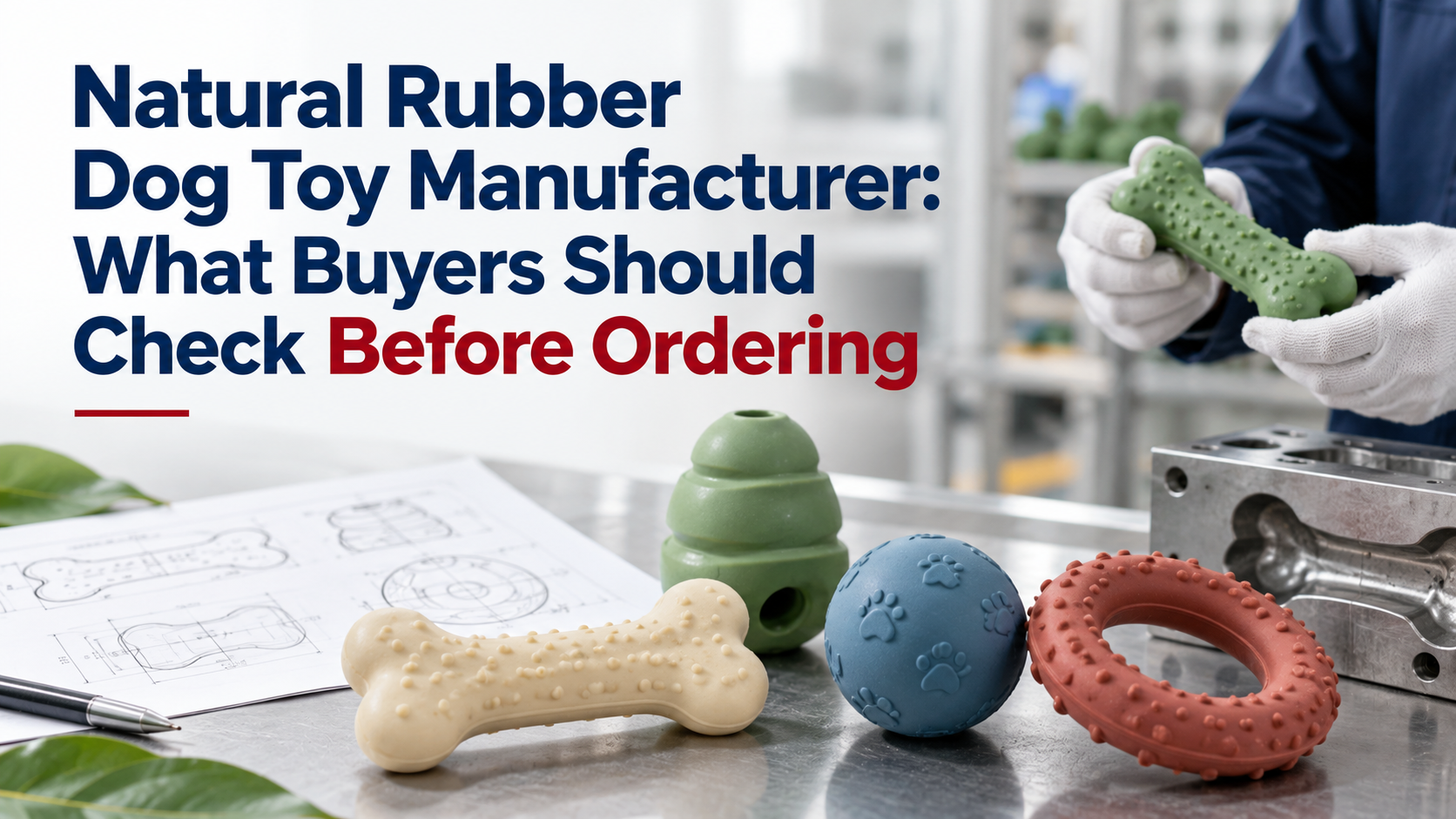
Choosing a natural rubber dog toy manufacturer requires more than comparing product photos, unit prices, and minimum order quantities. For pet brands developing chew toys, treat dispensers, rubber balls, tug
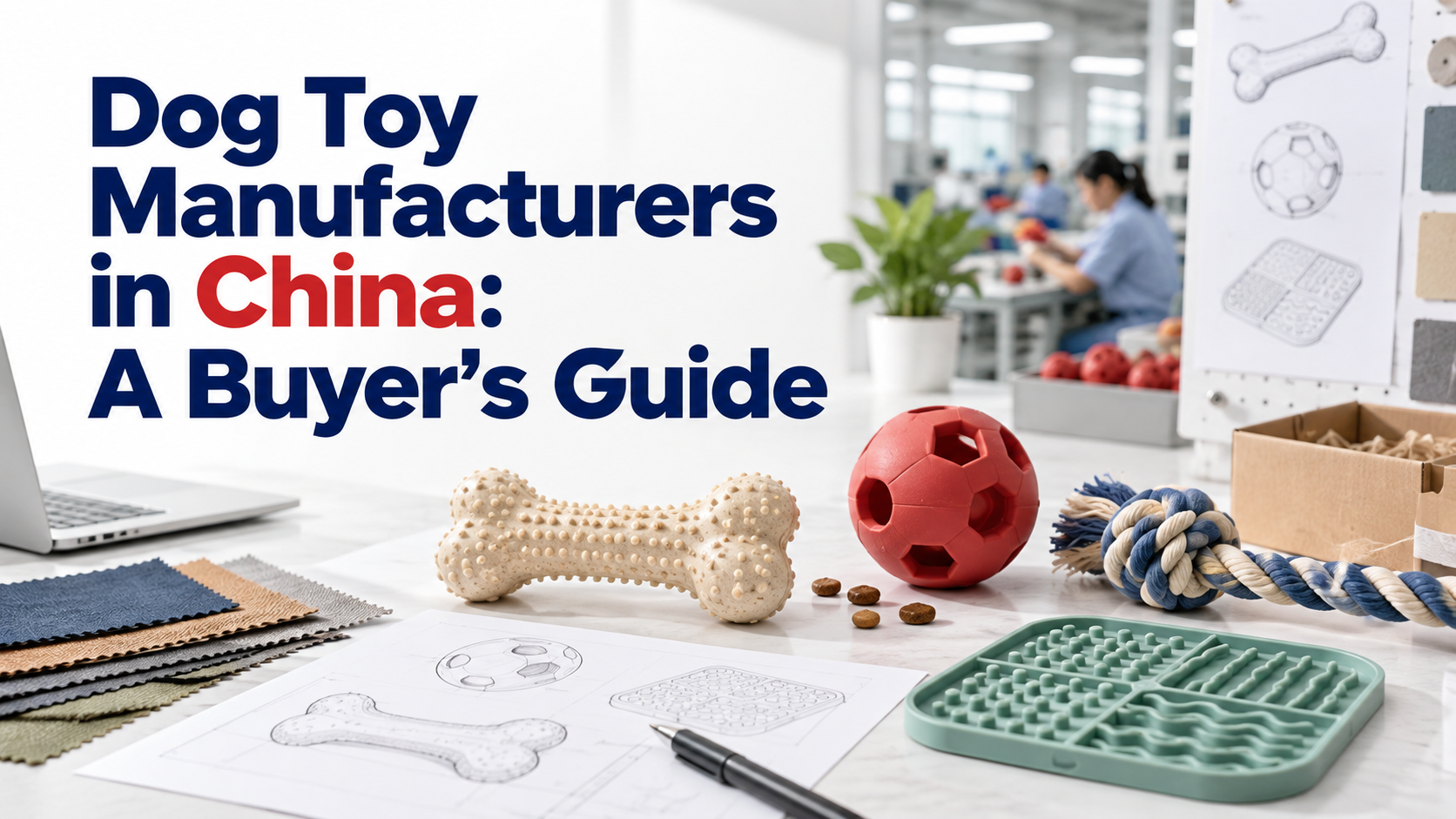
Dog Toy Manufacturers in China: A Buyer’s Guide
China has a large and diverse pet-product manufacturing ecosystem, but finding the right dog toy manufacturer in China requires more than simply searching for the lowest unit price.
Different factories specialize in very different products and processes. One supplier may focus on plush dog toys, another on molded natural rubber products, while others manufacture nylon chews, TPR toys, silicone enrichment products, or rope toys.
For pet brands, wholesalers, distributors, and private-label buyers, the real sourcing question is therefore not:
“Can I find dog toys in China?”
It is:
“Which Chinese manufacturer has the right material, engineering, tooling, testing, and production capabilities for my product?”
Quick Answer: To find a reliable dog toy manufacturer in China, start by defining
your product category, material, expected quantity, target market,
and level of customization.
Then evaluate potential factories based on product specialization,
material expertise, OEM/ODM capabilities, engineering support,
tooling, sampling, quality control, testing, MOQ, packaging,
production capacity, and communication.
What Does Custom Dog Toy Manufacturing in China Look Like?
A fully custom project normally moves through several development and production stages.
Product Idea → Requirements → CAD / DFM → Tooling →
Sampling → Testing → Approval → Mass Production →
QC → Packaging → Shipment
A supplier that only offers existing products with logo printing is very different from an OEM or ODM manufacturer capable of developing an original product.
Why Do Pet Brands Source Dog Toys From China?
China’s manufacturing advantage is not simply low-cost production.
The larger advantage is access to a broad supply chain covering materials, tooling, molding, printing, packaging, assembly, testing, and export logistics.
This allows pet brands to source and develop many different categories, including:
- Natural rubber chew toys
- Rubber dog balls
- Treat-dispensing toys
- Squeaky rubber toys
- TPR and TPE toys
- Nylon dog chews
- Rope toys
- Plush dog toys
- Silicone lick mats
- Silicone slow feeders
- Interactive enrichment products
- Outdoor pet accessories
However, these product types are not necessarily manufactured by the same kind of factory.
That is why supplier specialization matters.
1. Start With the Dog Toy Category
Natural Rubber Dog Toys
Natural rubber is commonly used for molded products such as:
- Chew toys
- Treat dispensers
- Rubber balls
- Tug toys
- Squeaky molded toys
- Puzzle toys
- Dental-texture toys
Manufacturing may involve rubber mixing, color preparation, compression molding, curing, demolding, trimming, inspection, and secondary processing.
If your project is a natural rubber product, look specifically for a manufacturer with rubber-molding experience rather than simply searching for a general pet-products supplier.
TPR and TPE Dog Toys
TPR and TPE are thermoplastic materials that can be injection molded.
They are commonly used for:
- Flexible chew toys
- Balls
- Dental toys
- Textured products
- Multi-material toys
These materials use a different production process from vulcanized natural rubber.
Nylon Dog Toys
Nylon chews are normally injection molded and provide a significantly harder chewing surface.
A factory specializing in rubber products may not necessarily have nylon injection-molding capability.
Plush Dog Toys
Plush manufacturing depends heavily on:
- Fabric sourcing
- Cutting
- Sewing
- Embroidery
- Filling
- Squeaker assembly
- Stitching strength
This is a fundamentally different manufacturing system from molded rubber toys.
Silicone Pet Products
Silicone is commonly used for feeding and enrichment products such as:
- Lick mats
- Slow feeder bowls
- Feeding mats
- Travel bowls
- Treat pouches
- Flexible pet accessories
You can explore Newtop Pets' silicone slow feeder and lick mat manufacturing capabilities for more examples.
2. Factory vs. Trading Company: What Is the Difference?
When searching online, many suppliers appear to be factories. Some are manufacturers, some are trading companies, and some combine both business models.
A factory normally controls production directly, while a trading company typically manages sourcing and customer communication through one or more manufacturing partners.
Neither model is automatically good or bad.
The important issue is transparency.
For a custom project, you should know:
- Where the product is actually manufactured
- Who controls the mold
- Who develops or selects the material
- Who approves engineering changes
- Where samples are manufactured
- Where quality inspection takes place
- Who is responsible for defects
- Whether you can communicate with the technical team
For a simple existing product, a trading company may work perfectly well.
For a complicated custom rubber dog toy, direct access to engineering, tooling, and production becomes much more important.
3. Check Whether the Manufacturer Offers OEM or ODM Services
Not every dog toy supplier in China provides the same level of customization.
| Model | Product Structure | Color / Logo | New Mold | Engineering Support |
|---|---|---|---|---|
| Wholesale | Existing | Limited | No | Low |
| Private Label | Existing | Yes | Usually No | Low |
| OEM | Existing or Custom | Yes | Possible | Medium |
| ODM | Custom | Yes | Yes | High |
If you already have a finished 3D drawing and specifications, OEM manufacturing may be sufficient.
If you only have a sketch, reference image, concept, or functional requirement, you may need deeper ODM support.
Learn more about Newtop Pets OEM and ODM customization .
4. Evaluate the Manufacturer’s Material Expertise
One of the most common sourcing mistakes is assuming that all flexible pet toys are manufactured in the same way.
Natural rubber, TPR, TPE, silicone, and nylon have different:
- Material properties
- Molding methods
- Tooling requirements
- Hardness ranges
- Tear behavior
- Surface characteristics
- Production costs
- Quality risks
For natural rubber chew toys, ask specifically about:
- Rubber formulation
- Shore A hardness
- Tear strength
- Tensile properties
- Wall thickness
- Curing
- Odor control
- Color consistency
- Flash control
- Post-processing
A supplier should be able to explain how the material and product structure work together.
5. Check Whether the Factory Can Help Improve the Design
An attractive 3D rendering is not automatically a manufacturable dog toy.
Design problems can include:
- Walls that are too thin
- Narrow neck sections
- Deep grooves
- Oversized treat openings
- Sharp internal corners
- Weak squeaker cavities
- Difficult demolding geometry
- Uneven material distribution
This is why DFM—Design for Manufacturing—should happen before mold production.
An experienced factory may recommend adjusting wall thickness, texture depth, hole size, product radius, parting lines, hardness, or internal cavities before tooling.
6. Ask Who Designs and Manufactures the Mold
For a custom dog toy, tooling can be one of the largest upfront investments.
Before ordering a mold, ask:
- Is mold design handled internally?
- Who machines the mold?
- What mold material will be used?
- How many cavities will it contain?
- What is the expected mold life?
- Who owns the mold?
- Is the mold exclusive?
- Where will it be stored?
- Who pays for modifications?
- Who pays for future maintenance?
Paying a mold fee does not automatically mean you own the tooling.
Ownership and exclusivity should be confirmed before payment.
7. Never Skip the Sampling Stage
A production sample should be treated as an engineering checkpoint, not simply a color sample.
Check:
- Dimensions
- Weight
- Hardness
- Flexibility
- Surface finish
- Texture
- Treat opening
- Wall thickness
- Bounce
- Squeaker performance
- Logo placement
- Parting line
- Flash
- Packaging fit
A small problem at the prototype stage is much easier to solve than the same problem across thousands of mass-produced units.
8. Ask How the Factory Controls Quality
One good sample does not guarantee consistent production.
Ask how quality is controlled throughout the manufacturing process.
Incoming Inspection
Materials and components are checked before production.
First Article Inspection
Initial production pieces are compared with the approved specification.
In-Process Inspection
Production can be monitored for dimensions, weight, hardness, appearance, and other critical parameters.
Final Inspection
Finished products are checked before packing or shipment.
For molded rubber toys, QC may include:
- Shore A hardness
- Dimensions
- Product weight
- Surface appearance
- Flash
- Color consistency
- Deformation
- Tear or tensile properties
- Functional testing
- Batch records
9. Understand Testing Before You Place an Order
“Pet safe” is not a complete technical specification.
Testing requirements can depend on material, product structure, destination market, retailer requirements, and product claims.
Before production, ask:
- Which tests can be performed internally?
- Which tests require a third-party laboratory?
- Does the report cover raw material or finished products?
- Who pays for testing?
- How long does testing take?
- What happens if a sample fails?
It is important to separate material compliance from finished-product performance.
10. Do Not Compare Suppliers Only by MOQ
There is no universal MOQ for custom dog toys.
MOQ can change according to:
- Product material
- Size
- Weight
- Color
- Custom tooling
- Logo process
- Packaging
- Accessories
- Customization level
Instead of asking only:
“What is your MOQ?”
ask:
“What MOQ applies to this exact specification?”
11. Compare Total Cost, Not Just Unit Price
A supplier with the lowest unit price is not automatically the lowest-cost supplier.
A custom dog toy project may include:
- Product design
- CAD development
- Prototypes
- Tooling
- Raw materials
- Manufacturing
- Logo application
- Testing
- Packaging
- Inspection
- Freight
Before comparing quotations, make sure each supplier is quoting the same material, dimensions, weight, hardness, quantity, color, logo, packaging, testing, and trade terms.
12. Check Packaging Capability
Many pet brands need retail-ready products rather than loose toys.
Ask whether the supplier supports:
- Polybags
- Hangtags
- Header cards
- Paper sleeves
- Color boxes
- Display boxes
- Barcode labels
- Custom inserts
- Instruction sheets
- Master cartons
Packaging MOQ should also be considered when planning your first production order.
13. Check Whether the Supplier Can Scale With Your Brand
The best supplier for a small test order may not be the best supplier for a large repeat order.
Ask about:
- Current production capacity
- Number of molding machines
- Peak-season lead times
- Additional tooling requirements
- Multi-cavity tooling
- Material availability
- Packaging capacity
- QC staffing
- Repeat-order lead times
14. Ask for a Clear Project Timeline
Custom manufacturing should be broken into milestones.
Requirements → Design → DFM → Tooling → First Sample →
Revision → Approval → Production → Inspection →
Packaging → Shipment
Do not rely only on a statement such as:
“Lead time: 30 days.”
That figure may refer only to mass production after the final sample has already been approved.
What Should You Send a Chinese Dog Toy Manufacturer?
Your first RFQ does not need to be perfect, but it should provide enough information for the manufacturer to understand your project.
Include:
- Product photo, sketch, drawing, or 3D file
- Approximate dimensions
- Preferred material
- Target hardness if known
- Dog size or intended use
- Estimated quantity
- Number of colors
- Pantone requirements
- Logo
- Packaging
- Target market
- Testing requirements
- Target launch date
If some information is still unknown, tell the manufacturer.
A good supplier should help convert incomplete requirements into a clear production specification.
Red Flags When Choosing a Dog Toy Factory in China
- Cannot clearly explain where production takes place
- Refuses to discuss material specifications
- Provides a final quotation from only one photo
- Cannot explain its molding process
- Avoids questions about mold ownership
- Has no clear sampling process
- Changes specifications without documentation
- Cannot explain its QC process
- Promises every possible material and process
A strong manufacturer does not need to say yes to everything.
Identifying what cannot be manufactured reliably can actually be a sign of better technical judgment.
Questions to Ask a Dog Toy Manufacturer in China
Do you manufacture this product in your own facility?
What materials do you specialize in?
Can you support OEM and ODM development?
Can you start from a sketch or product concept?
Who designs and owns the mold?
Can you provide prototype samples?
How do you control hardness and dimensions?
What testing can you support?
What is the MOQ for my exact specification?
Can you provide custom packaging?
What is the tooling lead time?
What is the mass-production lead time?
How do you handle defective products?
Can production scale when order volume increases?
China vs. U.S. Dog Toy Manufacturing
Both China and the United States have established dog toy manufacturers.
The right sourcing location depends on the project rather than one country being universally better.
| Factor | China | USA |
|---|---|---|
| Custom Tooling | Widely available | Available |
| OEM / ODM Ecosystem | Broad | Supplier dependent |
| U.S. Domestic Shipping | International freight required | Simpler |
| Supply Chain Breadth | Broad across many categories | More supplier-specific |
| Packaging Integration | Widely available | Supplier dependent |
| Engineering Support | Supplier dependent | Supplier dependent |
| MOQ | Depends on project | Depends on project |
For more detail, see our guide to dog toy manufacturers in the USA .
Example: Custom Rubber and Silicone Pet Manufacturing in China
Newtop Pets is a China-based OEM/ODM pet-product manufacturer focused on custom natural rubber dog toys and silicone pet products.
Depending on the project, customization can include:
- Pantone color matching
- Custom logos
- Custom packaging
- Product dimensions
- Texture changes
- Shore hardness options
- Functional adjustments
- 3D design support
- New mold development
- Prototype sampling
- Exclusive product development
Explore our dog toy product range or review our OEM and ODM customization process .
Frequently Asked Questions
Are dog toys manufactured in China?
Yes. China manufactures many types of dog toys, including natural rubber toys, TPR and TPE products, nylon chews, plush toys, rope toys, silicone enrichment products, and pet accessories.
How do I find a dog toy manufacturer in China?
Start with your product type and material, then compare suppliers based on specialization, tooling, OEM/ODM capability, sampling, quality control, testing, MOQ, packaging, production capacity, and communication.
Can Chinese manufacturers make a dog toy from my design?
Yes. Some OEM/ODM manufacturers can work from a 3D file, drawing, sketch, reference product, or early product concept. The amount of engineering support depends on the supplier.
What is the MOQ for custom dog toys in China?
There is no universal MOQ. It depends on material, product size, manufacturing process, color, logo, packaging, tooling requirements, and customization level.
How much does a custom dog toy mold cost in China?
There is no standard mold price. Cost depends on product size, mold dimensions, complexity, number of cavities, mold material, textures, undercuts, and expected production volume.
Who owns the mold when manufacturing in China?
Mold ownership depends on the agreement with the manufacturer. If exclusivity matters, ownership, storage, permitted use, maintenance, and restrictions should be confirmed before tooling begins.
Is China suitable for private-label dog toys?
Yes. Many suppliers offer private-label services such as custom colors, logos, packaging, labels, and product variations. Private labeling, however, is different from developing a fully original OEM or ODM product.
Final Thoughts
China offers a broad dog toy manufacturing ecosystem, but successful sourcing depends on choosing the right type of supplier.
Do not choose a manufacturer simply because it appears first in a marketplace search or offers the lowest quotation.
Start with your product.
Define the material, function, customization level, target quantity, market, testing requirements, and packaging.
Then choose a manufacturer whose material expertise, engineering capability, tooling, sampling process, quality control, communication, and production capacity match those requirements.
For a standard product, private labeling may be sufficient.
For a modified product, deeper OEM support may be required.
For a proprietary dog toy developed from a concept or sketch, look for an ODM manufacturing partner capable of supporting the complete process from design through mass production.
Looking for a Custom Dog Toy Manufacturer in China?
Newtop Pets supports pet brands, wholesalers, distributors, and private-label programs with custom natural rubber dog toys and silicone pet products.
From existing-product customization to 3D development, new molds, prototypes, colors, logos, packaging, and mass production, we support different levels of OEM and ODM projects.
Start Your Custom Project →


